
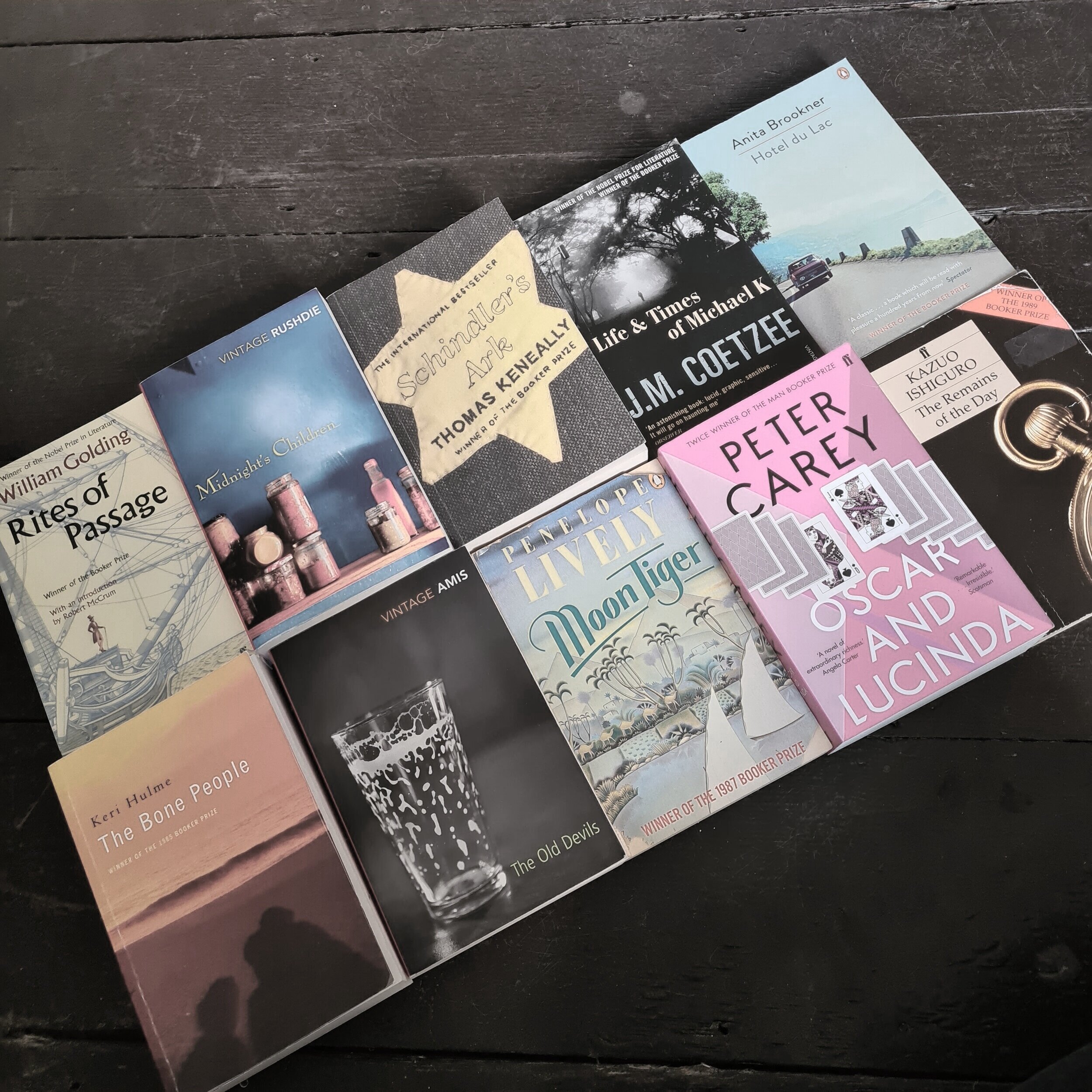

The Booker in the 2010s
The 2010s were a hugely significant decade for the Booker, largely due to the shift in rules which came into place in 2014. From that year onwards, the Prize was open to all novels published in the English language, replacing the long-held (and many might say, dated) criteria that focused on authors of British, Irish and Commonwealth heritage. This shift led to a lot of hand-wringing and fretting about the potential “domination” of the Prize by US authors, and a dilution of what the Prize stood for.

The Testaments (2019)
The Testaments revisits Gilead (the setting of The Handmaid’s Tale) via a number of new perspectives, each shedding new light on the dystopian world Atwood created some three and half decades previously. The first is a covert diary written to a future audience by The Handmaid’s Tale’s fearsome Aunt Lydia, describing how she became a part of the regime as well as how she comes to subtly undermine it from inside; the second a testimony from Agnes, a girl who has grown up knowing nothing other than the Gilead regime; and the third from Daisy, a teenager in Toronto who has viewed Gilead from the outside, but will have to face its realities first hand (for various spoilerish reasons.)

The Handmaid’s Tale (1986)
The Handmaid’s Tale, for anyone who’s been living under a rock and is somehow not familiar with its plot, is essentially the tale of a dystopian, totalitarian version of America, known as Gilead, seen through the eyes of one of its presumably millions of ordinary female victims - Offred - who, as one of the diminishing number of fertile women in an aggressively patriarchal society, is assigned to the role of “handmaid”, essentially a house-slave of her “commander” whose sole purpose is to bear him and his wife a child.

Girl, Woman, Other (2019)
Girl, Woman, Other follows the lives of 12 characters, predominantly black and female, in the UK over the course of the twentieth and early twenty-first century. Each of the 12 main sections is told in the voice of those characters, whose lives cross over, in some cases intimately and in others highly tangentially, with the other characters in the book. The first chapter focuses on the build-up to the launch of its central character, Amma's new play, The Last Amazon of Dahomey, opening at the National Theatre. The final chapter takes place at the play's afterparty, at which many of the present-day characters are present or in the minds of those attending.

Milkman (2018)
Milkman is told in the distinctive voice of an unnamed 18-year-old "middle sister" trying to go about her life in an unnamed city in peak-Troubles Northern Ireland. She is stalked and harrassed by a 41-year-old paramilitary officer known only as "Milkman". False rumours spread that she is in a relationship with this character, affecting her relationship with her mother, the wider community, and her "maybe-boyfriend".
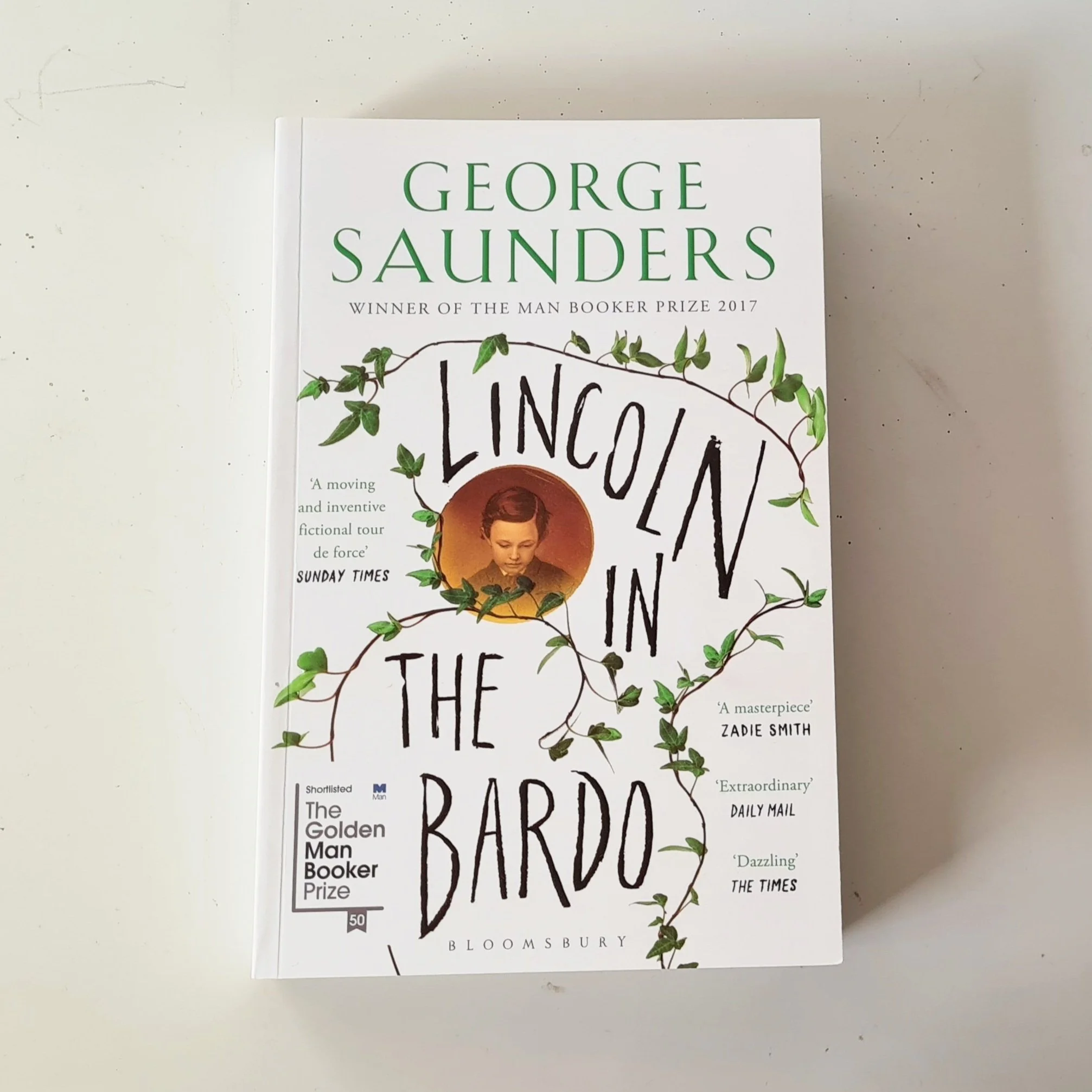
Lincoln in the Bardo (2017)
Lincoln in the Bardo focuses on the death of Abraham Lincoln's son Willie. It focuses (not sequentially) on the build-up to his death (in which the Lincoln's host a party while Willie lies bed-ridden), his death itself, and the aftermath, in which the grieving president visits his son's crypt and holds his body, all apparently based in historical fact. So far, so simple? Well… the above summary does absolutely no justice to what this novel actually is, which is a joyously unusual thing that mixes historical accounts (real and invented) of those events with a wild supernatural narrative set in the "bardo", a Buddhist term for the "intermediate state" between death and resurrection.

The Sellout (2016)
The Sellout takes place in the fictional town of Dickens, California, an agrarian town around LA. It begins with its narrator, an African-American farmer whose father has recently been unjustly killed by police, known only as "Me", or "Bonbon" - a nickname, standing trial before the Supreme Court for crimes related to his attempt to restore slavery and segregation in Dickens. What follows is an examination of the alternately painfully real and highly surreal events that led to this seemingly absurd scenario.

A Brief History of Seven Killings (2015)
A Brief History of Seven Killings is about an attempt on the life of Bob Marley in 1976. Except, of course, it’s about far more than that. It’s also far from brief at almost 700 dense pages, and covers considerably more than seven killings, typically in graphic and visceral detail. It’s actually about several decades of complex and violent Jamaican history, told through a multiplicity of voices from gang leaders to politicians, journalists and seemingly peripheral “ordinary” people. Oh, and a ghost. Because of course.

The Narrow Road To The Deep North (2014)
The Narrow Road to the Deep North tells the story of Dorrigo Evans, a famed war veteran and public figure in his later years, who considers his accolades to be unjustly earned. The novel reflects on major moments in his life, most centrally his role in the Australian Imperial Force during World War II and his regiment's internment as hard labourers on the notorious Burma Death Railway. In this period he is reluctantly installed as the commander of his regiment in the camp, and is forced into making numerous impossible choices that will inevitably lead to the death of his comrades. Against this is a constant thread focusing on his obsession with his brief affair with his uncle's wife, Amy, prior to the war, and his ongoing post-war infidelities to his wife and mother of his children, Ella.

The Luminaries (2013)
The Luminaries takes us to New Zealand, during the Gold Rush years in the mid Nineteenth Century. In straightforward plot terms, it’s a mystery novel centering on the aftermath of a series of seemingly disconnected events in the town of Hokitika. Central is the death of a little-known hermit, Crosbie Wells, alongside the disappearance of a rich young prospector, Emery Staines, and the arrest of opiate-addicted prostitute Anna Wetherell.

Bring Up The Bodies (2012)
Bring Up the Bodies is the sequel to Mantel's 2009 Booker winner, Wolf Hall. It continues to follow the life of Thomas Cromwell, blacksmith's son now risen to Master Secretary to the King's Privy Council. King Henry VIII is tiring of his second wife Anne Boleyn, who has yet to bear him a male heir, and beginning to fall in love with Jane Seymour, a former attendant to the Queen and inhabitant of Wolf Hall.
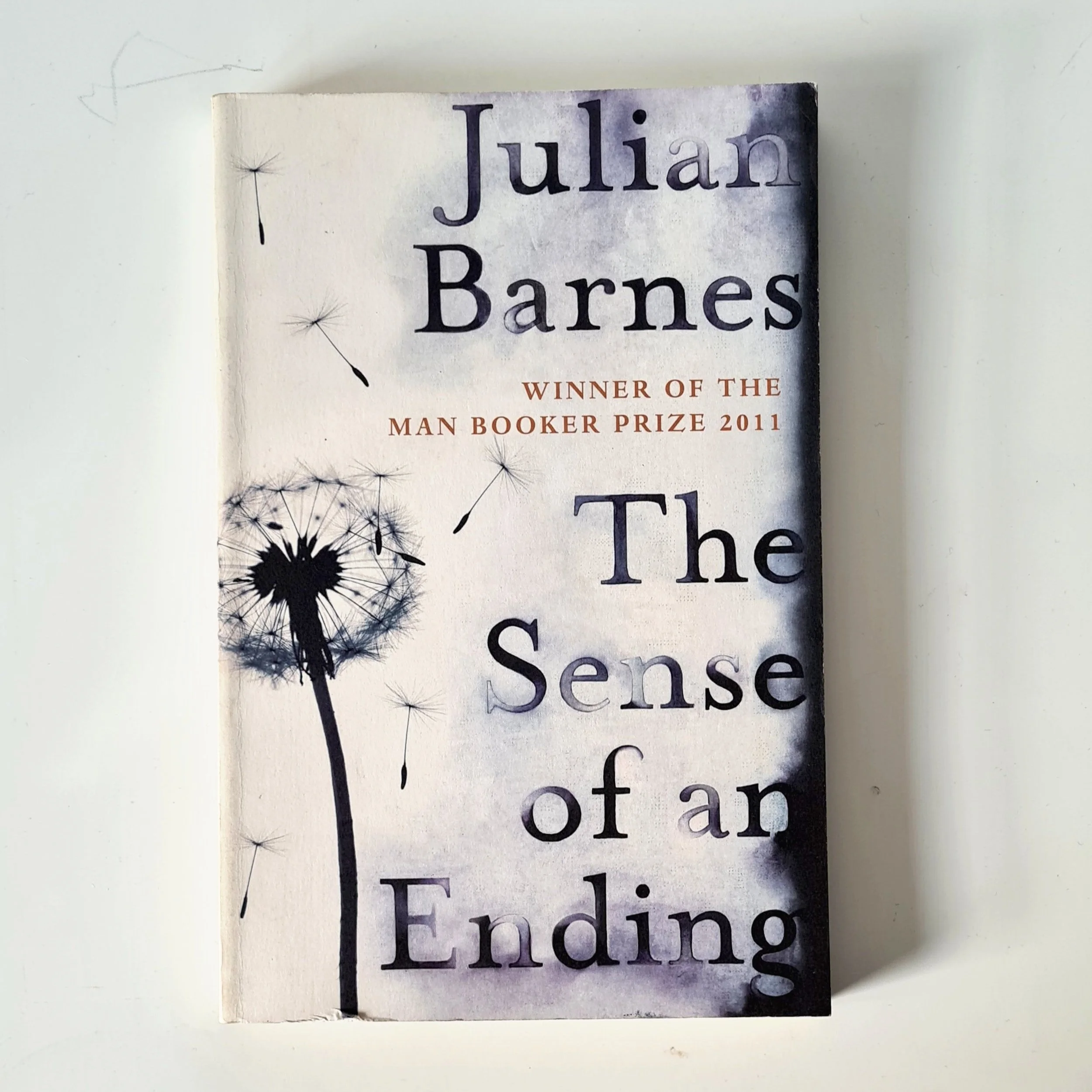
The Sense of an Ending (2011)
The Sense of an Ending is a short novel narrated by a retired, divorced man named Tony Webster. Its first part sees him recalling a series of incidents from his schooldays, largely concerning his group of intellectual / pretentious friends, of which the most significant is the newcomer Adrian. Eventually the two head off to separate universities where Tony has a short, unsatisfying relationship with a girl called Veronica, which involves an awkward visit to her family, and a meeting with his schoolfriends in London. Towards the end of his degree, he finds out that Adrian is dating Veronica. Not long afterwards, he finds out that Adrian has committed suicide, with a letter to the coroner citing philosophical reasons, which Tony admires.

The Finkler Question (2010)
The Finkler Question is a comic but thought-provoking novel focusing largely on the lives and relationships between three men. Julian Treslove is a former BBC radio producer, drifting through middle age with a lack of direction and stable relationship, and working as an impersonator of various Hollywood stars. He is friends with two men who are both recently widowed: Sam Finkler, his old school friend, is a popular Jewish philosopher and TV personality, and Libor Sevcik is their former teacher and a former Hollywood gossip columnist, nearing ninety.

The Booker in the Noughties
The Booker in the Nineties was all big ideas, grand narratives and excess, a decade distilled in book form under the glare of the tabloid press. In some sense this held true as the new millennium rolled over… and it some senses, well, it didn’t at all. As in the rest of life, and culture, the Booker in the Noughties felt more fragmented. More individual stories shining a light on hitherto ignored groups, but with the dominant Bookerati never too far around the corner.

The Inheritance of Loss (2006)
The Inheritance of Loss is a novel that focuses on the diverse experiences of the inhabitants of a decaying colonial-era mansion in Kalimpong, and their relatives and friends. The primary focus is on two characters: Sai, an orphan living with her grandfather, retired judge Jemubhai Patel; and Biju, the son of the house's cook, who is living in New York illegally.

The Line of Beauty (2004)
The Line of Beauty is a 1980s-set novel covered the peak years of Margaret Thatcher’s Conservative rule and the growth of the AIDS crisis. It focuses on Nick Guest, a recent Oxford graduate writing his PhD on Henry James. Now living in a Notting Hill townhouse belonging to the parents of his college friend (and crush) Toby Fedden. The patriarch of the family is Thatcher-obsessed MP Gerald Fedden, married to Rachel and also father to Catherine, a troubled character who forms a closer bond with Nick.
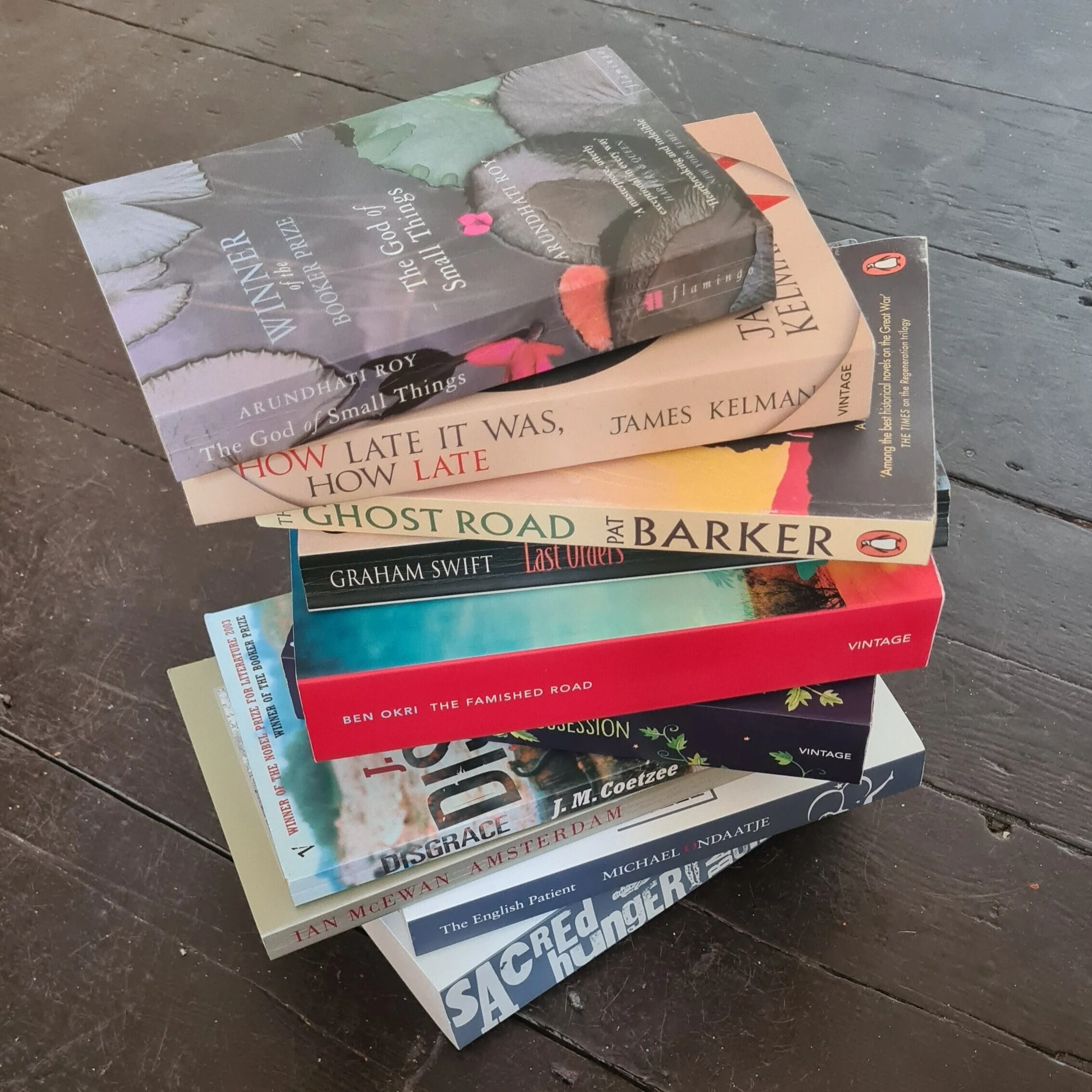
The Booker in the Nineties
In this mass media glare of the 90s Booker, there’s evidence here and there of yet more self-consciousness on the part of the rotating panel of judges. There’s the occasional tendency to try to replicate old success stories, which more often than not falls flat. Experimentation happens here and there, welcome when it does, however successful. We start to get a firmer sense of “Booker type” novels, leading to a sense of exhaustion with some of the winners. More importantly, the sense that many of those “Booker type” novels come from the pens of a certain “Booker type” author (white, middle class, overwhelmingly male) can no longer be ignored.

Disgrace (1999)
Disgrace is told from the perspective of David Lurie, a divorced literature professor at a university in post-Apartheid Cape Town. The first half of the novel details Lurie’s life as an aging academic and Byron obsessive, satisfying himself with weekly visits to prostitutes. He loses everything following his pursuit and eventual rape of a young female student, and subsequent refusal to co-operate with an enquiry that seems designed to protect him.

The Booker in the Eighties
After the Seventies saw the Booker taking its tentative first steps, stumbling here and there, occasionally landing on a genuine classic but more often than not serving up curiosities rather than solid-gold genius, we venture into more solid ground in the Eighties.
There’s a sense here of more self-awareness, of the need for winners to feel “important” and make a statement of some kind. There are certainly more hits than misses, and even the latter are perhaps in some ways more interesting than those of the previous decade.

The Remains of the Day (1989)
The Remains of the Day focuses on Stevens, an experienced butler at the top of his trade, but coming towards his twilight years, and in the employ of a newly-arrived American businessman following years of dedicated service to the aristocratic Lord Darlington. The first-person narrative is located in the 1950s, with Stevens in charge of much-reduced staff from his glory days, and beginning to notice small errors in his previously perfectionist work. He accepts his employer’s offer of a break, for the purposes of which he borrows his car and heads off on a tour of the South West of England, part of which will involve a visit to an old colleague, Miss Kenton.