Bring the House Down (2025)
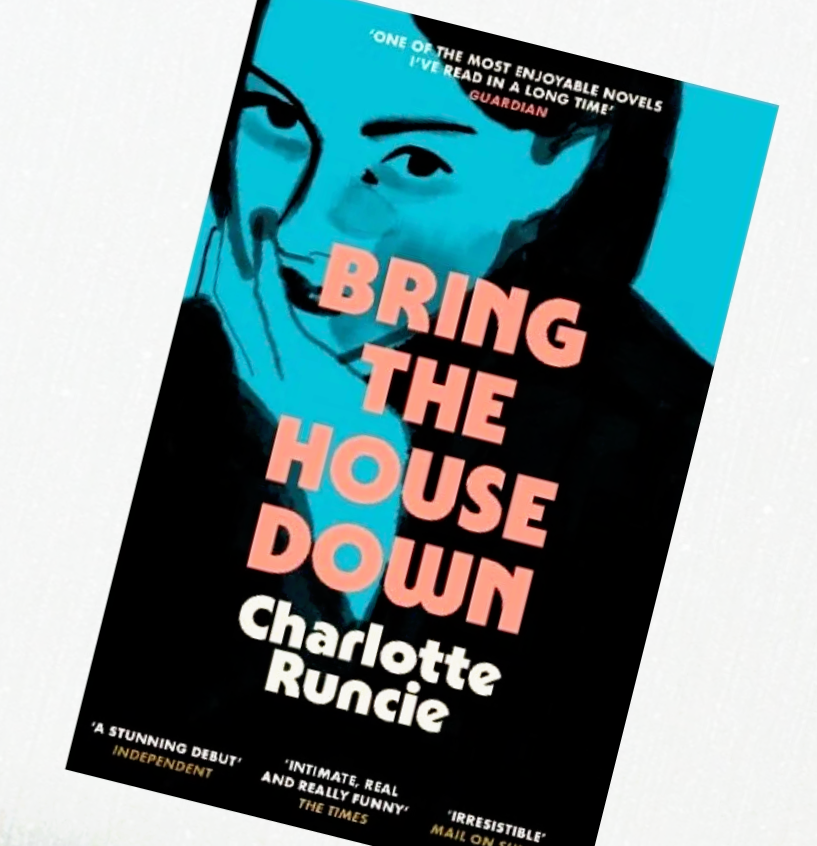
Why this one?
A belated Netgalley pick that I was surprised to see still available to read - I guess because the paperback is due in April. I was looking for something a little lighter (in style if not necessarily subject matter) after a few recent heavy going reads.
Charlotte Runcie (1989- ; active 2006-) was born in Edinburgh, Scotland. She studied English at Cambridge, and while still a student there won the Foyle Young Poet of the Year (2006) and Christopher Tower Poetry Prize (2009). She subsequently became an arts journalist, writing for most of the major UK papers and most recently acting as the Telegraph’s senior arts columnist and radio critic.
In 2019 she published Salt on Your Tongue: Women and the Sea, a non-fiction work which was chosen as a Radio 4 Book of the Week. She currently lives in South Wales, hosts a books and culture podcast, In Haste, and is studying for a PhD in medieval literature at Bristol University. Bring the House Down is her debut novel, released in 2025.
Thoughts, etc.
Bring the House Down takes place during the Edinburgh Festival, and focuses largely on the arts critic Alex Lyons, and the aftermath of a one star review he gives to a show at the festival. He’s clearly something of an amoral womaniser, and seems set to meet his downfall after sleeping with Hayley, the American star of the aforementioned one-star show before the review has been published. The novel is told from the perspective of Alex’s colleague Sophie, whose viewpoint is clouded not only by her proximity to Lyons, but also by grief, and difficulties in her own relationship and family situation, making her an interesting choice to narrate what seems to be an otherwise fairly black and white story.
The first sections of this book are genuinely gripping, particularly the painful hours that take place between the hookup and Hayley finding out about Alex’s review (which of course he didn’t mention). It’s also then intriguing to see where it’s going to go next, as Hayley rips up her original production and builds something new out of the ashes of her mistreatment by Alex. From there on in, it’s a little more hit and miss but never not interesting.
The misses for me were actually around the main through line of the story. Once the first night of Hayley’s show is complete, I don’t know if I feel her character really saw much in the way of development. She’s there as a representative of a version of the ‘MeToo’ movement but we get to know very little about her as a person. Yes, there’s a later moment in which we see her questioning her decisions when Sophie interviews her, but even that revealed precious little. She’s something of a flat cipher, and we see her mostly through the lens of online discussions about her. Maybe that’s the point, I guess, but it did feel like something of a missed opportunity to hear a more rounded take on her story than the mediated one we get.
Alex is more interestingly handled, almost excessively sympathetic in some ways. We get to delve into his past, in which we find excuses for his behaviour (rejection as an actor, nepo baby drama, etc) and even in his worst moments (seducing his best mate’s teenage sister) he’s given the chance to ‘explain’ himself, slightly dulling the impact. I get that this is an attempt to not paint him entirely as a one dimensional character, but it does feel at times like he’s being given anti-hero status when he’s basically just a dick. I dunno.
In a lot of ways this is more Sophie’s book than its central protagonists. While the fireworks between the two aforementioned characters give us the moments that jump off the page and stick in our heads, a lot of the novel’s more heartfelt and thought-provoking moments belong to Sophie. Her relationship with her own partner is more interesting, with a past infidelity on his side regularly mentioned but not detailed, and her own occasionally ambivalent relationship to her relationship with him takes up a lot of space. The most affecting thread for me, as a dad, was the unpicking of the often unspoken motivations that lead to conflict between new parents. Her partner’s depiction of his role as a dad was rather moving, even if a relatively small part of the book.
At times it’s hard to see how Sophie’s own story connects to the headline narrative, however interesting it may be. Thinking about it afterwards, though, one reading is potentially that the Alex/Hayley story is really just fuel for Sophie’s own concerns around her career and in particular the role of the critic in the modern world. It doesn’t entirely work as it becomes so dominant a part of the book that at times Sophie seems inconsequential, but it’s actually her thoughts on criticism that for me were the most engaging part of the book. Is Alex’s reputation being trashed because he’s fundamentally a dick to women (entirely fair) or because people have had enough of honest criticism? The truth is somewhere in between, of course, and we get that nuance from Sophie where the others’ perspectives might have been more black and white either way.
We then dig into Sophie’s own fears around criticism - at the start of the book she’s unable to contemplate the notion of giving a one star review, but as she steps temporarily into Alex’s shoes she finds herself conflicted. First, she entrenches herself further in that position, becoming increasingly convinced of the importance of not crushing the hopes of creators who have put their life and soul (and often significant money) into their productions. But ultimately she finds a production that, regardless of all of this, cannot be justified, and submits her own Alex-style panning. We sense that she’s on her way out of criticism by the book’s end, but not before she’s had a good go of reemphasising its importance.
It’s a book with a lot of memorable moments, a good number of thought-provoking concepts, and at least one well-rounded character in its narrator. It’s an easy and at times gripping read, particularly in its early chapters and (for the visual excitement at least) its closing moments. For me, it didn’t always hang together, occasionally seeming unsure of what it wanted to say and even what kind of book it wanted to be. I’m all for shades of grey in writing, but at times this one did feel like it would have benefitted from a little less fence-sitting.

Score
7
Interesting and at times really powerful, if not entirely coherent.
Next up
Belatedly jumping into one or two from the Women’s Prize longlist…