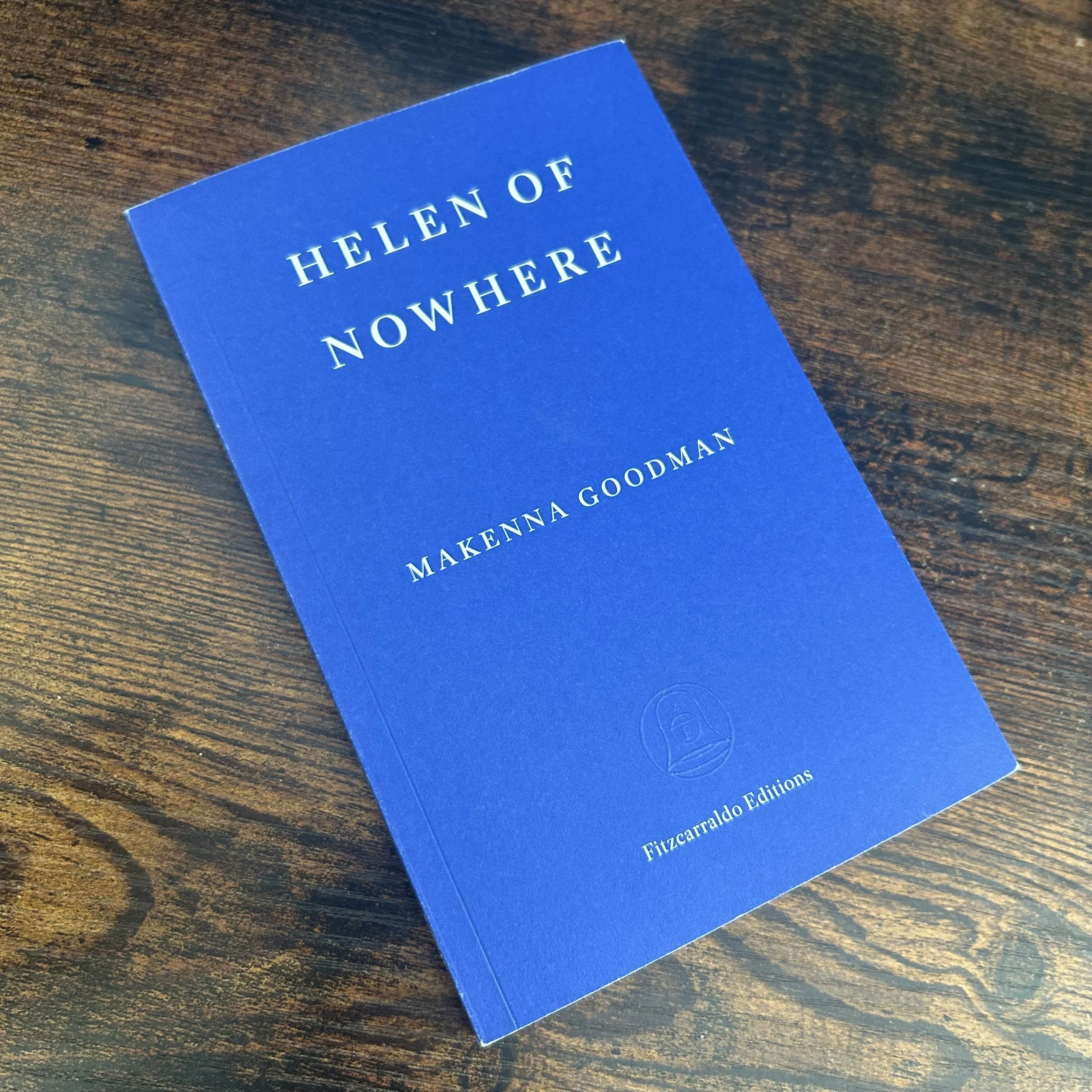
Helen of Nowhere (2025)
Why this one?
A random pick after seeing some endorsements on Instagram, I think.
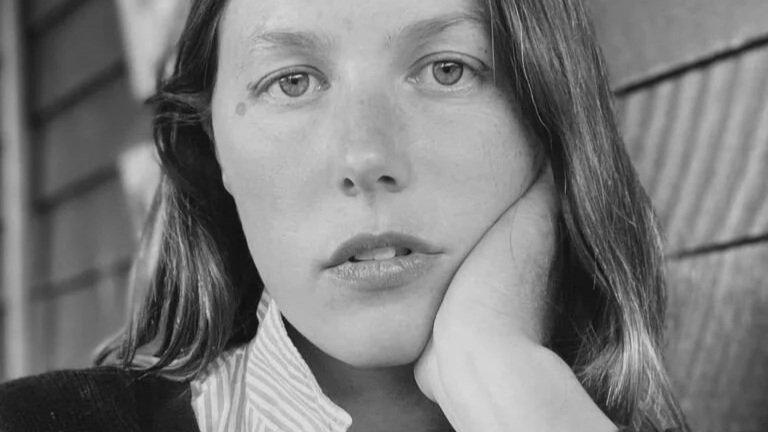
Makenna Goodman was born in Colorado, US. She started her career as an editorial assistant for a major publisher in New York. She subsequently worked as a literary agent for a year before apparently being fired. She moved to Vermont to focus on writing, but ended up getting a job as an editor at a radical small press focusing on agriculture and the natural world. She is currently executive editor at Timber Press.
Her first novel, The Shame, was written in secret in the 2010s, and released in 2020. Helen of Nowhere is her second novel, published by Coffee House Press in the US and Fitzcarraldo Editions in the UK. Alongside her novels, she has written extensively in the non-fiction field, publishing essays and literary criticism in numerous major titles.
Thoughts, etc.
Helen of Nowhere focuses on an academic, known only as ‘Man’, who has recently lost his job as an English professor and separated from his wife (‘Wife’). He taught on largely transcendentalist themes, which are now being challenged by his (largely female) colleagues and students. His accusation that a student’s work may have been plagiarised was apparently the root of his dismissal, but he believes that he was in the process of being managed out in any case. His wife appears to have tired of him for numerous reasons, and is focused on her own writing career. ‘Man’ is considering a move to the country, and is shown around a large property by ‘Realtor’. The property’s former owner ‘Helen’ is now apparently in care, and has left the task of its sale to the realtor who apparently also lived in the house with her for some time.
After some time at the house, he enters into some sort of séance in which he ‘meets’ Helen, who seems to be suspiciously similar to the realtor. He seems to find the prospect of the encounter with this character, who has been built up as a quasi-mythical ‘earth mother’ figure to be initially arousing, but through their communing he is led to question some of his assumptions about his role in his own downfall. In a final section, we see him return to his wife’s home in a position of submission (acting as a dog or even a baby), seemingly in final acceptance of the true role she has played in nurturing his career, life and ego, and imagining now deferring to her needs instead.
As a reading experience, I found it somewhat disconcerting, which I think is very much deliberate. It begins in a generally realist mode, covering the well-trodden ground of a disgraced professor seemingly seeking some kind of redemption via trying to commune with the nature that has formed the basis of his study for so long. It fairly rapidly becomes clear that he’s an unreliable narrator, myopically committed to his own worldview in spite of the evidence racking up against him that suggests that there may be much more to the story of his downfall than he is revealing.
Once he’s at the property, things get considerably more complex. He approaches the property as a kind of academic coloniser, drawing on his worldview to analyse and idealise the character of ‘Helen’ as loosely presented by the Realtor. The Realtor herself is not a simple character, taking on a role that seems to be first a heightened take on her job (‘selling’ Man an idealised fantasy of the life he could be buying into) and then becoming someone who interrogates Man and forces him to question his firmly held beliefs, first directly (claiming knowledge of his life story that leads us to suspect she may just be a facet of his own character) and then later in the seance section more obliquely (though at this point whether it’s the Realtor or Helen or neither and just the Man’s imagination… who knows)
‘Helen’ herself is deliberately near impossible to pin down. For much of the book it seems she’s invented by the Realtor as a sales gimmick. At times then she seems to be Man’s own invention, a fantasy character through which he can work through his demons. And then we get a section in her voice is which she tells a fairly straightforward and realist tale about allowing some kids to use the lake on her land and her parents then turning on her. Within this tale (probably the most engaging and ‘relatable’ part of the book in some ways) are some more interesting questions about ‘who owns the land’ - beneath the fantasy ‘earth mother’ vibe she is (if she exists, who knows again) actually just another property owner and therefore subject to the normal rules of society, despite the ‘back to nature’ fantasy Man has invested so heavily in.
While this book is well-crafted and intriguing, I did leave it with a sense of befuddlement, as much as anything else. I don’t think that is accidental on the part of Goodman. She’s clearly aiming to give the reader plenty to think about, rather than presenting a straightforward story in which the purpose and ‘moral’ is clear. Hazy ideas of what is real and unreal are used to highlight the instability of any worldview, even as it’s at least generally obvious that the character most in need of having his perspective checked is ‘Man’. In simple terms, the book seems to be a process of unpicking his certainties, taking him on a journey from solid reality through interrogative fantasy and ultimately to a kind of surreal reinvention. But it’s not the sort of book where any ‘simple’ interpretation is likely to be correct in itself. There’s more to it, of course, but what? And do I care?
Score
6.5
An interesting intellectual exercise with moments that elevate it beyond that. But overall just maybe a little too much of a puzzle and not enough of a pleasure for my liking.
Next up
Possibly back to some Netgalley upcomers…