Dominion (2025)
Why this one?
Reading the Women’s Prize for Fiction shortlist, after reading some from the longlist that mostly didn’t make it. This is the third of the six shortlist books for me.
Addie E. Citchens (1980- ; active c. 2020- ) was born in Clarksdale, Mississippi, and currently resides in New Orleans, Louisiana. She earned her undergraduate degree from Jackson State University and subsequently completed the Florida State University Creative Writing Programme and the Callaloo Creative Writing Workshop. Prior to publishing Dominion, her debut novel, Citchens focused on short fiction and non-fiction, including much relating to music history. Her non-fiction research on the history of the blues has been featured in Mississippi Folklife and broadcast on The Mississippi Arts Hour via Mississippi Public Broadcasting. Her short stories and essays have appeared in publications such as The New Yorker, The Paris Review, and the Oxford American. She was selected as the inaugural recipient of the Farrar, Straus and Giroux Writer’s Fellowship, and her short story “That Girl” won the O. Henry Prize.
Thoughts, etc.
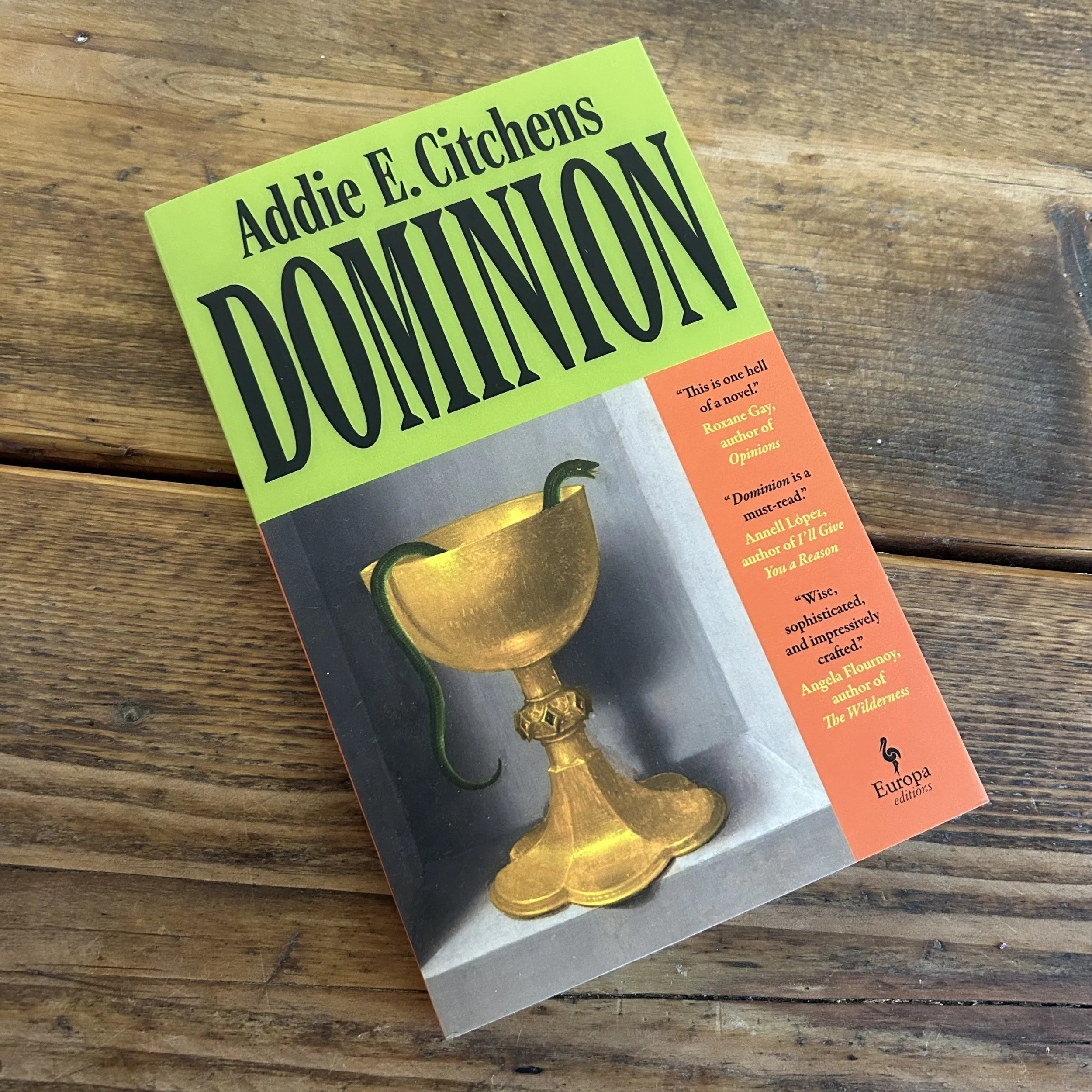
Dominion is set in the fictional small town of Dominion, Mississippi in the year 2000. The novel focuses on the Winfrey family, with the family’s patriarch Sabre Winfrey Jr. the reverend of the Seven Seals Baptist Church, as well as a locally successful entrepreneur. The Winfreys outwardly represent the pinnacle of Southern Black success and religious devotion. Behind this facade, though, is a more unflattering reality, with Sabre’s relationship with his wife Priscilla somewhat broken by his relentless infidelities and hypocrisy.
Adding another layer to the tension between public appearances and private drama is the central story of their youngest son Emanuel, nicknamed "Wonderboy." Emanuel is a talented musician and singer and a star high school football player who has inherited some of his father’s less godly tendencies. Priscilla witnesses a sexual encounter between Emanuel and Diamond, a vulnerable local teenager who has fallen blindly in love with him, which disturbs her and raises her suspicions around the realities of his character. Emanuel is later accused of sexual violence to several young women, but even before that the depths of his darkness are revealed as he responds to a sexual incident with an anonymous by murdering the local character who witnesses it and attempts to blackmail him.
The book is mainly told from the perspectives of Priscilla and Diamond, framing it clearly as the story of the women in the community and how they are impacted by the actions of the men. The latter present publicly as paragons of virtue, the father a celebrated preacher and pillar of the local community, and the son the embodiment of teenage masculinity, with flawless academics alongside sporting heroics. Their success draws vulnerable women into their orbit, often with disastrous consequences for the women, and allows them to do pretty much whatever they want with total impunity. (At various points, the suggestion of criminal investigations into any of the men in the community are mocked; their friends run the local police force, of course, meaning that any attempt to bring them to justice is something the women have to take into their own hands, as the book’s conclusion proves).
The only punctuations of the women’s perspective are the notes from Sabre’s religious journals / plans for his sermons, which offer a window into the extent of his somewhat manic religious fervour on paper, which mainly represents an exercise in attempting to convince even himself of his spiritual worthiness, in the face of all the evidence to the contrary. This sort of works as it shows us enough about what’s going on in Sabre’s head without granting him too much narrative space with which to justify his deeds.
Less satisfying for me was the lack of voice given to Emanuel in the book. To be fair, much of the story does revolve around him and there’s clearly a purposeful decision in giving voice to the women affected by him (not just a feminist justice, but also a narrative purpose - the two women are two who begin the book naturally disposed to believing in Emanuel’s perfection - a mother and an obsessed teen lover - who must come to their own conclusions about the men’s shady behaviour in order to begin to free themselves from it). But in the central incident that causes the young prodigy to unleash murderous rage and sow the seeds of his eventual undoing, there’s too much for me that goes unanswered.
Not least is the fact that the rage is induced by the potential for a crack in his idea of perfect masculinity to be exposed. I wanted to know more about this hint at sexual complexity in this important character, rather than just have a that moment used as the spark for violence. Perhaps that’s my privilege showing though - reacting to the possible eruption of unconventional sexuality in a religious community in the American South, suppressing it via violence it may be a very logical choice (and one that’s been learned first hand from his father).

Score
7.5
Overall there was a lot to take in here: I did find the characters compelling and the sense of place really well rendered. It’s atmospheric and has a real sense of tension and foreboding throughout. Its central themes of distrust of all forms of conferred authority (religious, patriarchal) resonated and raised some interesting questions. I just wished that it had had a bit more space to unpick some of the other intriguing threads that it raised but didn’t really resolve.
Like the sound of this one? Buy it at bookshop.org.
(If you click through and make a purchase, I may earn a small commission from Bookshop.org at no additional cost to you, which helps support local independent bookshops. I’ll only share these links for the highest rated titles on the site. )
Next up
Dominion