The Correspondent (2025)
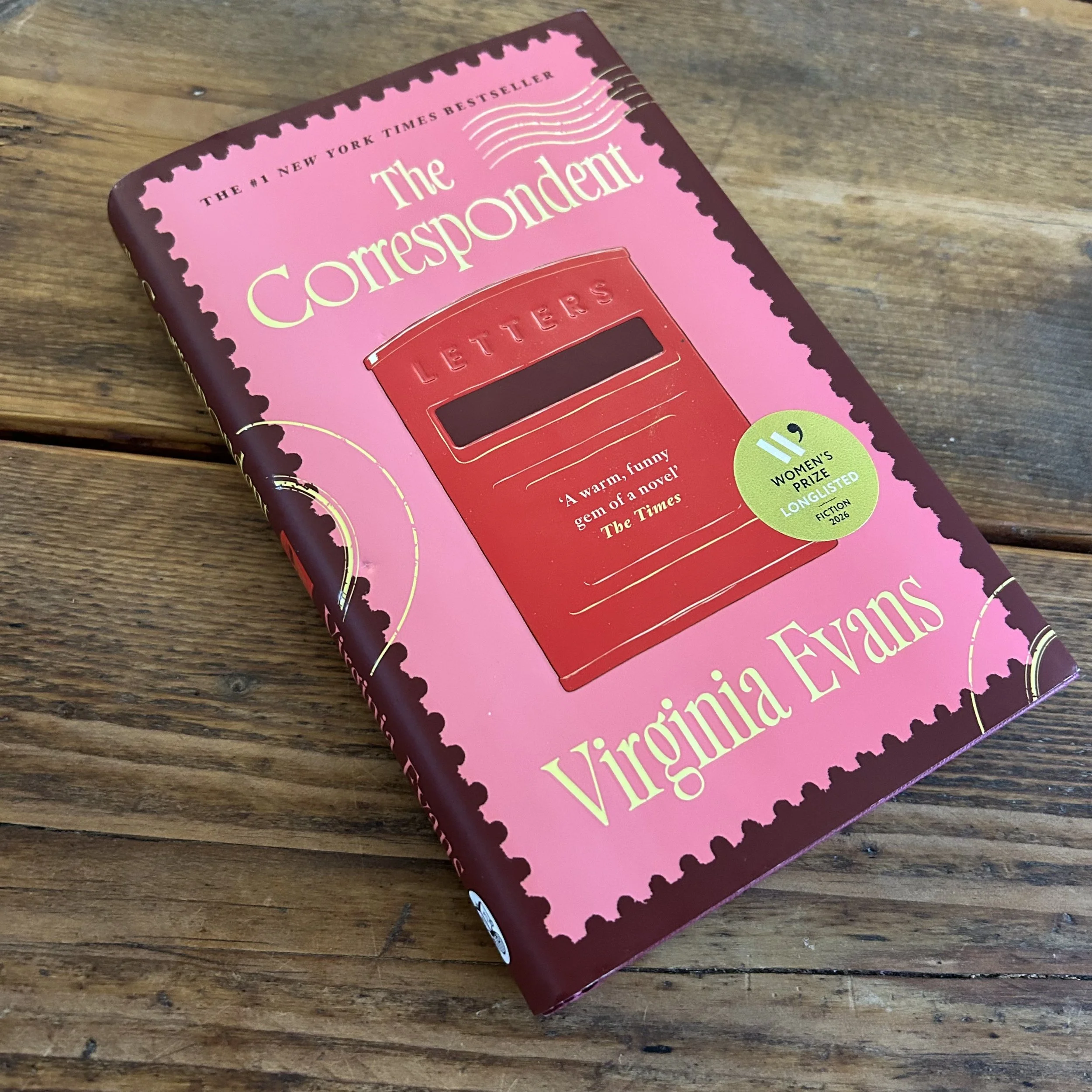
Why this one?
After the announcement of the 2026 Women’s Prize shortlist I had 5/6 still left to read. Moving on from all the great books from the longlist that didn’t make it, this was the first of the remaining contenders that I picked up.
Virginia Evans (1986- ; active 2019-) was brough up in Severna Park, Maryland, USA. She studied English Literature at James Madison University in Virginia, before later moving to Ireland to pursue a Master’s in Creative Writing at Trinity College Dublin, where she studied under a range of notable authors including Claire Keegan.
Prior to the publication of The Correspondent in 2025, she had been writing since the age of 19, completing seven ‘unsuccessful’ novels in the intervening years (including one that she self-published in 2015). She worked various jobs over those years, including (notably for this book) a brief stint as a bankruptcy lawyer. She now lives back in the United States in Winston-Salem, North Carolina, with her husband and two children. The Correspondent has been a runaway commercial success, topping the NYT bestseller list, and also recently won the PEN/Hemingway Award for Debut Novel.
Thoughts, etc.
The Correspondent is an epistolary novel told via the letters from and to the 73-year-old retired lawyer Sybil Van Antwerp, mostly covering a span of her later life in the 2010s. Living in Annapolis, Maryland, she is generally an ‘ordinary woman’ who is notable primarily for her commitment to the art of letter-writing (though she does also dabble in emails where absolutely necessary). The book covers her letters to friends and relatives, and the authors of books that she loves (including a notable correspondence with Joan Didion), as well as a few more interesting interchanges that form the basis of significant plot developments.
One of these is with an Syrian immigrant employee of a DNA heritage testing kit, through which she uncovers a connection to her birth family (she was adopted as an infant). Elsewhere, there’s a regular communication with a highly intelligent but troubled teenager called Harry Landy, to whom she begins to act as a kind of surrogate mother. Troubling missives from an angry character signed only as ‘DM’ relate back to an incident from many years ago in her legal career. There are romantic overtones from two very different elder gentlemen - a Texan with a penchant for booze and guns, and a humble but rather charming German neighbour, Theodore Lubeck, who has his own hidden history to come to terms with.
Most notable of all though, are a series of unsent letters to an unnamed recipient, through which she documents both her responses to all of the above, as well as revealing some of her deeper issues that she doesn’t tend to talk about in her sent letters. In these letters she reveals more about her desire to know more about her adoption and therefore her identity, but also about the grief she experienced following the loss of one of her own children in an accident at the age of 8, the impact of this incident on her relationship with her ex-husband Daan (now dying of cancer) and on her ongoing relationship with her surviving children, notably her distant daughter Fiona.
There is a huge amount going on in this relative short book. It’s structurally very well done, with the range of letters allowing the concurrent development of these many threads in the seemingly ‘ordinary’ later life of its central protagonist, and the ‘unsent letter’ thread hinting at - and ultimately revealing - the book’s deeper emotional heart, rooted in the incomparable trauma of the grief for the loss of a child (and the associated guilt - justified or not - that Sybil feels for her role in that loss).
Sybil is initially presented as a somewhat abrasive character, a little self-righteous, occasionally pompous, and rather withering in her assessment of anyone who doesn’t meet her very high standards. But even in these early pages, there’s plenty to love about her characterisation, which initially comes across as very Olive Kitteridge. She’s certainly a character who knows her own mind, but her putdowns are hilarious, her occasionally ‘senior mis-steps’ equally funny and while she can occasionally come across as petty, we eventually understand that most of her foibles have roots in very deep and relatable issues. (A letter to a newspaper early in the book, in which Sybil responds with unconstrained rage to an article highlighting a parent’s role in their child’s accidental death, is an early hint of where things will ultimately go.)
It’s a book that plays well to its intended audience, with Sybil’s self-professed status as a ‘literary snob’ providing some easy laughs and empathy for a crowd of reader (like this blogger) who get some (if not all) of her references. She tends towards the classics, but it’s her engagement with recent authors (often explored in her correspondence with her lifelong friend Rosalie) that is most interesting. She’s amusingly (and predictably) dismissive of the likes of Dan Brown and Stieg Larsson but seems intrigued by Kazuo Ishiguro (whose Never Let Me Go is discussed at some length). The latter I found intriguing, along with several references to John Williams’ Stoner, which feels like an obvious influence in terms of its examination of the quiet dignity of an ordinary life, and interest in later-life reflection (notably, Sybil also expresses admiration for Ishiguro’s The Remains of the Day in her letter to him, another book with similar concerns).
While its format makes it a little less stylistically coherent than either of those books, it’s in that focus on reflective self-examination that it’s most effective, at times devastatingly so. While there are certainly moments of joy and humour peppered throughout this book, it hits hardest when it zooms in on those moments at which small decisions in a life can have huge, long-resonating consequences, both on those involved and their families and other relationships. In its ending we see Sybil engaging in person, in some form, with things that she has previously kept at a distance via her writing. This is in some senses forced - we know that throughout the book she has been losing her sight at rapid pace and coming to terms with a life in which she cannot have quite the same focus on reading and writing. But it also allows her some closure around issues that perhaps through writing alone she could never quite resolve.
Score
9
One of those books that contains multitudes. Easy to see why it has found popular resonance, with its treatment of universal issues like aging and grief, and crowd-pleasing humour and popular literary references. But also with a quietly reflective depth that makes it an ultimately very satisfying read and more than worthy entry on the shortlist.
Like the sound of this one? Buy it at bookshop.org.
(If you click through and make a purchase, I may earn a small commission from Bookshop.org at no additional cost to you, which helps support local independent bookshops. I’ll only share these links for the highest rated titles on the site. )
Next up
Dominion