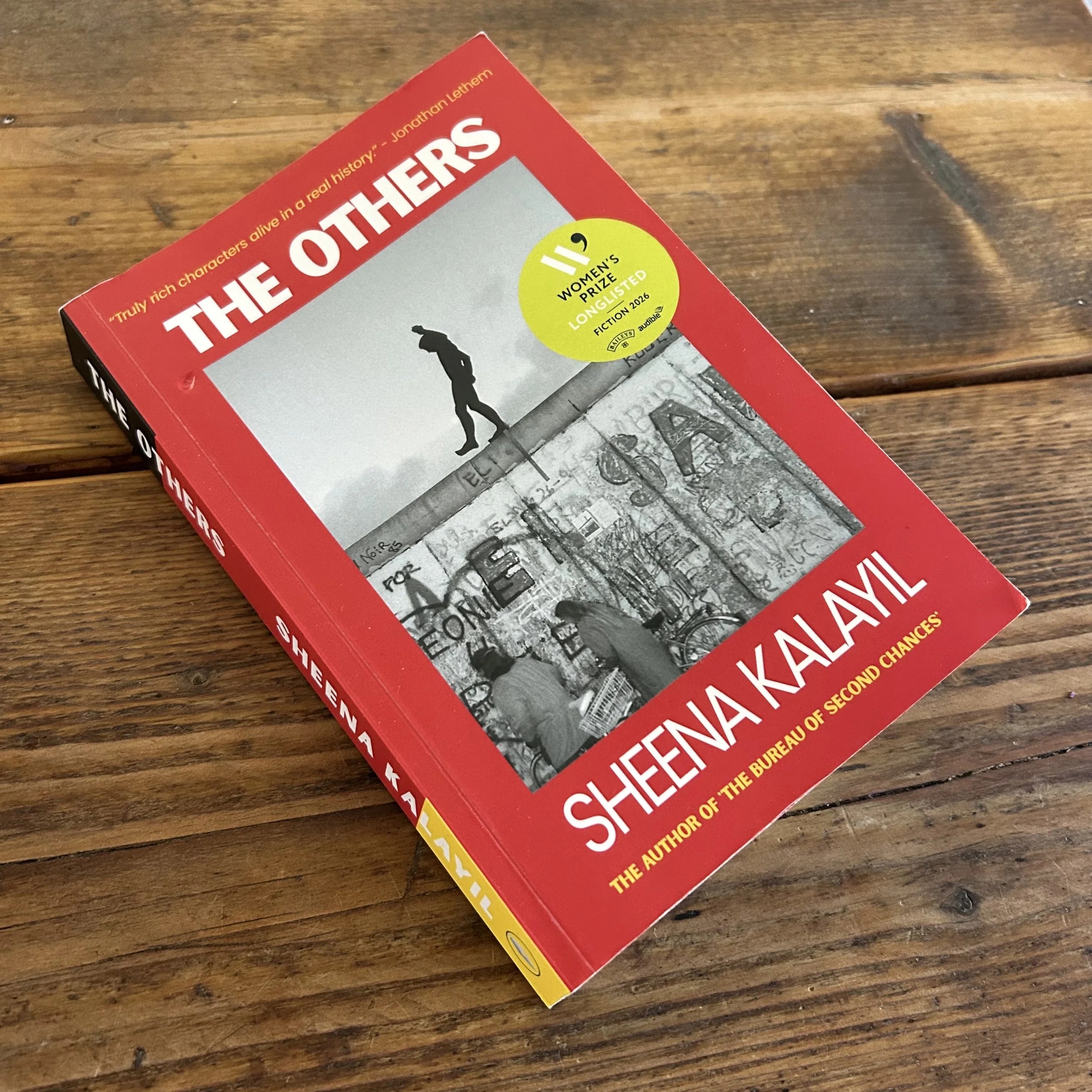
The Others (2025)
Why this one?
This was my final selection from the 2026 Women’s Prize for Fiction longlist, prior to the announcement of the shortlist. This one didn’t make the shortlist (of which more later) and nor did most of the ones I’d read so far. The exception was Flashlight, which I enjoyed back when it appeared on the Booker list but by the time this one rolled around I’d actually forgotten that I’d read it. So there’s that. I was especially disappointed that Audition (just brilliant) and The Benefactors (a great book to think and talk about) didn’t make it. Anyhow here we are.
Sheena Kalayil (1970- ; active 2015-) was born in Zambia to parents from Kerala, India. Her upbringing was nomadic, spanning Zambia, Zimbabwe, and India before she moved to the United Kingdom aged 18. She studied engineering in Budapest, Hungary, where she lived during the collapse of the Soviet Union. She currently lives in Manchester where she works as a lecturer in Intercultural Communication at the University of Manchester. Her research focuses on multilingualism and heritage languages among South Asians in Britain.
Kalayil’s career as a published novelist began in her late forties, following years spent teaching in countries such as Nepal, Mozambique, and Venezuela. Her debut novel, The Bureau of Second Chances (2017), won the Writers' Guild Award for Best First Novel and was shortlisted for an Edward Stanford Prize. This was followed by The Inheritance (2018) andThe Wild Wind (2019). The Others is her fourth novel, published in 2025, and the first to appear on the Women’s Prize longlist.
Thoughts, etc.
The Others is based in a ‘small coastal city’ (modelled on Rostock) in the north of East Germany, and begins early in 1989, prior to the seismic geopolitical changes that took place over the course of that year. It focuses on a love triangle between three very different characters: at the heart of it is Lolita, a medical student from India; with Armando (a factory worker on a labour exchange from Mozambique) and Theo (an East German mechanic and aspiring writer) vying for her attention. At the start of the novel, Armando and Lolita are on an early date, accompanied by Armando’s daughter Clara (with ex-lover Petra, an East German journalist), when they come across the body of a drowned man, who apparently lost his life while attempting an escape to Denmark. Their involvement in his discovery attracts the attention of the Stasi, leading to increased tensions over their already precarious position as ‘others’ in the tightly controlled regime.
While there is evidently high chemistry between Armando and Lolita, their relationship is made challenging by various aspects of their circumstances and personalities. In a cooling-off period, Lolita meets Theo who attempts to seduce her, with some degree of success. While he grabs her attention with his poetry and way with words, his physical manner is somewhat more clunky and there’s no similarly obvious chemistry between the two. In the course of this clumsy seduction Lolita is introduced to Theo’s grandfather Rainer, a charming survivor of wartime France who has secrets of his own. During this meeting, Lolita reveals details of her and Armando’s discovery of the drowned man, which later make Armando’s position even more vulnerable (Lolita herself is protected by her connection to a compatriot who seems to have connections in the right places; Armando has no such safety net).
Soon, those seismic changes intervene and seem to render these challenges at least superficially less menacing. The Wall falls, and our main characters have all made their way to see it. While Lolita begins the events with Theo, she ends up with Armando, as Theo gets to experience his long dreamed-of passage into the West under an unwelcome cloud of rejection. The novel’s climactic events (in the book’s main time period, at least) see the three protagonists experiencing the collapse of the Soviet Bloc from wildly differing perspectives. Theo, while temporarily subdued, has a new world of opportunities open to him. Armando and Lolita’s seemingly promisingly revived relationship, however, seems obviously doomed - they are not permitted the same freedom of passage as Theo. They must return to the collapsing East and figure out how best to negotiate their futures in a way that focuses more on the bare necessities of survival and familial duty rather than the extravagance of the artist calling Theo is able to pursue. A brutal conclusion for Petra, the mother of Armando’s beloved child, effectively collateral damage in the chaos of the collapsing country they inhabit, seals the lovers’ fate.
In some ways, that’s maybe where the story should have ended. Instead we get a coda set in the present day in which a comfortably successful Theo tries to piece together what happened to his erstwhile rival and love interest, involving an encounter with a grown-up Clara. It is in some senses -necessary: the light it sheds on the plight of those like Armando who came to Germany with the promise of a financially secure future only to have it cruelly withdrawn from them on an effective technicality is important to highlight, and a story I personally was not familiar with. However I did get left with a sense that this ending was a little too tacked-on and an overly tidy way of wrapping up what had up to that point been a very subtly and engagingly developed novel.
I actually spent much of the book’s first half wondering if it was quite going to do it for me. I’d picked it up on the promise of a story set at the heart of a critical event in postwar European history, and for much of the early part of The Others that history is very much in the background. Of course we are firmly situated in that reality by the discovery of the body, but after that for a while the history takes a back seat to an admittedly quite compelling love triangle narrative (not normally my thing, if I’m honest, but well done here). Eventually it does become apparent that this was scene-setting, establishing the characters in the ‘real’ world of their day-to-day problems in which by the late period of the Soviet era what seems remarkable to us from the vantage point of history had become normal, and therefore generally unworthy of detailed discussion even by directly-impacted characters.
In any case, the book’s second half does a great job of thrusting us firmly back into the brilliantly-rendered reality of those historical events, for better (the celebratory mood in Berlin) and worse (the threats faced by Armando before those events, and their unforeseen consequences for Petra). Its characters are extremely compelling, particularly Lolita and Armando (Theo has a role to play, but he never feels like he’s as much of an interest for the author, making his central role in the coda at once disappointing and maybe understandable - he’s in a sense an outsider in a different way, the documenter and observer of a story more interesting than his own). It’s a great concept that is for the most part beautifully executed, and its roots in moments of Kalayil’s own personal history shine through (she was present in Budapest at the time of the fall of the Wall in Germany, experiencing the celebrations from an adjacent perspective; and later worked in Mozambique where she witnessed the ongoing protests by the workers who were never compensated for their labour in East Germany).
Score
8.5
A very satisfying read that I would have been very happy to see on the shortlist.
Like the sound of this one? Buy it at bookshop.org.
(If you click through and make a purchase, I may earn a small commission from Bookshop.org at no additional cost to you, which helps support local independent bookshops. I’ll only share these links for the highest rated titles on the site. )
Next up
The Correspondent