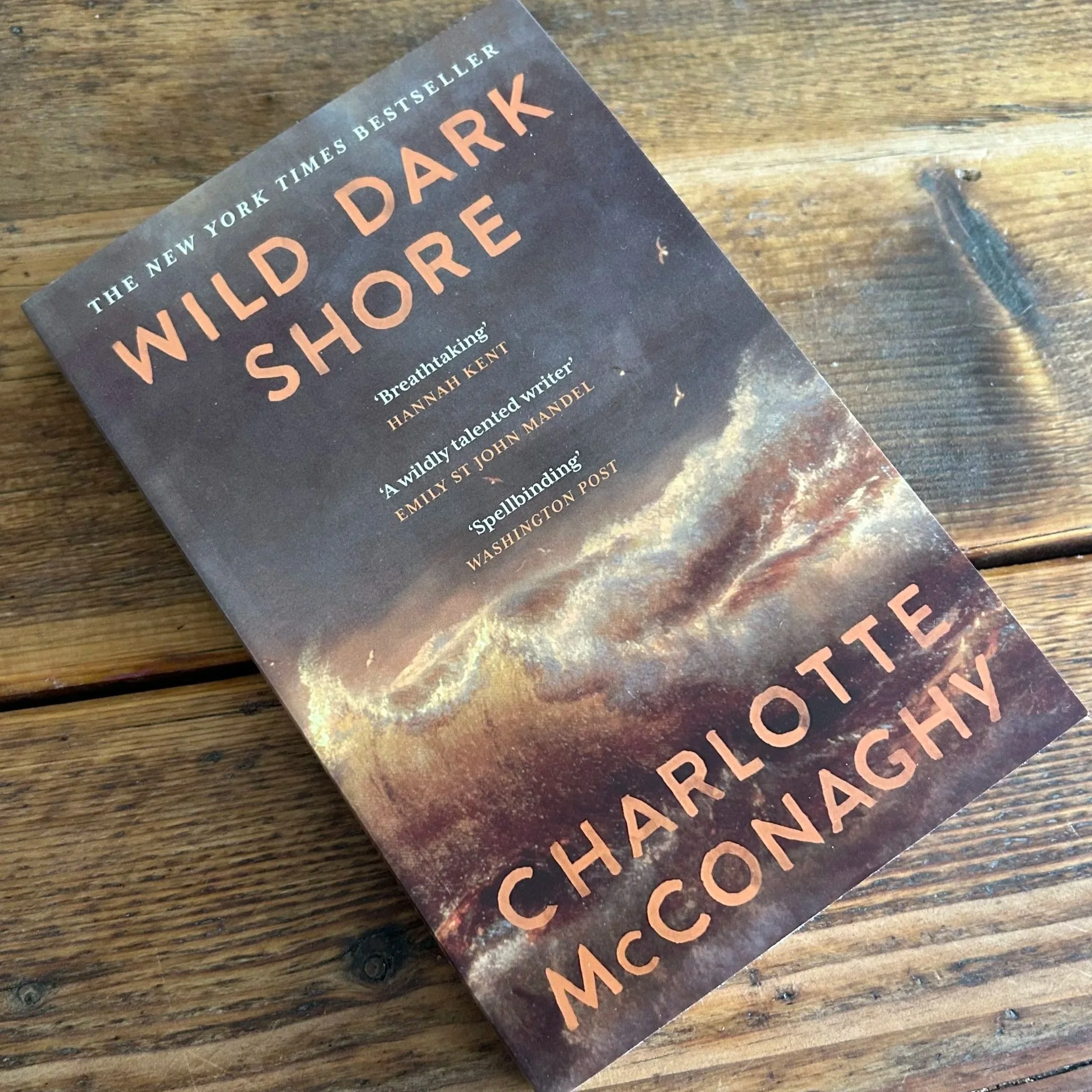
Wild Dark Shore (2025)
Why this one?
I’m dipping into a few books from the 2026 Women’s Prize for Fiction longlist, with the eventual goal of reading the full shortlist. This one is my fifth so far, again based on Instagram recommendations.
Charlotte McConaghy (1988- ; active 2005-) was born in Darwin, Australia. She attended the Australian Film, Television and Radio School, in Sydney, from which she received a master's degree in 2012. She has written from a young age, and published several books in a young adult series (The Chronicles of Kaya) as well as writing Science Fiction. Her first ‘literary’ work aimed at adults was 2020’sMigrations,, swiftly followed by Once There Were Wolves (2021). Both deal with environmental issues and the natural world, and both have screen adaptations in the works. Wild Dark Shore was published in 2025, is a New York Times bestseller, and has been shortlisted for numerous awards.
Thoughts, etc.
Wild Dark Shore is set on the fictional Shearwater Island (inspired by the real-world Macquarie Island) between Australia and Antarctica. Its sole inhabitants (aside from thousands of penguins and seals) are Dominic Salt and his three children. Following the departure of a group of research scientists as sea levels rise to dangerous levels, the Salt family are the sole caretakers of the world’s largest remaining seed vault. Their isolation is shattered by the arrival of the battered and barely alive body of Rowan. While the family nurse her back to health, there are evidently secrets on both sides. Rowan is both drawn to Dominic and his children and repelled by a succession of discoveries that raise suspicions.
The novel alternates between the voices of its main protagonists, largely Dominic, Rowan and the Salt children. Dominic is a stoic, hard-working type, still grieving for his wife after many years and ploughing his energy into constant work as a barrier to contemplation. His eldest son Raff (a sensitive type, a musician who has recently suffered grief of his own and who has been taught by his father to punch his way through it with the aid of boxing training) and daughter Fen (who seems to live largely on the island’s beaches with the seals) have helped raise his youngest, the ten-year-old Orly. The latter is obsessed with the seeds, and his stories of seeds, their role in nature and how they are being threatened punctuate the narrative, in segments that are both brimming with Orly’s childish wonder and doom-laden in the face of our awareness of the increasing threats to their survival.
The book is set in the near future, another of many recent reads in which the climate emergency is visiting itself with ever more force and urgency on all parts of the world. Once a respite from its worst effects, Shearwater is succumbing rapidly, and the dramas and tragedies experienced by its last inhabitants are emblematic of the island itself about to go under. Alongside the modern day drama, we hear tales of the islands past in which colonial plunderers battered legions of seals to death and boiled armies of penguins in giant metal buckets, which still stand on the edges of the island, for now at least surrounded by the temporarily happier descendants of those innumerable poor creatures.
Prior to her arrival, Rowan has experienced the crisis first-hand, building a dream house in a forest filled with natural life in Australia before seeing it razed by wildfire, and its wildlife near-obliterated. Having refused the idea of bringing her own children into the world in the midst of this apocalyptic tragedy, she forms bonds with Salt kids, especially Orly, despite casually informing him that they will all soon either burn, starve or drown, along with everyone and everything else.
We learn relatively soon into the book that Rowan was in the vicinity of the island because she was searching for her husband Hank, one of the research scientists who had been due to return home soon, but had been sending her increasingly desperate and frightening communications, apparently fearing for his life. There is mounting evidence that Dominic and Hank have had some kind of run-in, but Rowan takes some time to pin down what has happened. In the meantime, naturally, she begins to fall in love with Dominic.
This is a book with a huge amount going on. It’s on one level a beautiful elegy for a dying world, symbolised by an island which has gone through phases as site of ecological violence, sanctuary for millions of nature’s most threatened creatures, and most recently as one of the last bastions of hope in the midst of climate disaster. It’s a moving story of a family united - and at times ripped apart - by grief and isolation. It’s a multi-layered thriller, in which one surprise follows another. And it’s a romance of sorts, albeit an ultimately doomed one.
At times it’s perhaps almost too much. The thriller plot certainly keeps you turning those pages, but can also feel over-engineered at times (and relies a little too much on suspension of disbelief when it comes to the coincidences and convenient overlooking of the obvious that frequently occur). Aspects of it sometimes edge close to melodrama. But ultimately its positives far outweigh those concerns. Its depiction of the impending climate meltdown is beautifully done, with the mood one of sadness and loss rather than hysteria.
Its characters are memorable, especially the children - who we really come to care for, particularly as they are knocked about throughout by tragedy after tragedy, near misses with violent deaths, all while subject to isolation from society through no choice of their own. We also, as is common in stories like this, see their fates (especially that of Orly, the youngest) as bound up with the fate of the planet - in them there is the beauty of the world and some shred of hope for the future. Whether that hope is ultimately misplaced or that their survival - for however long - is cause enough to keep believing, fighting against what seems to be the inevitable, and pushing on forward, is the question on which the book hangs everything, of course quite rightly neglecting to supply us with an easy conclusion.
Score
9
It’s in many ways a deeply bleak read, but also one that has the slightly moderating quality of a wake-like celebration of a dying civilisation. As it documents an ending, it finds a lot to celebrate in what has been lost, and also in what persists against all odds. Definitely a more-than-worthy shortlist contender.
Like the sound of this one? Buy it at bookshop.org.
(If you click through and make a purchase, I may earn a small commission from Bookshop.org at no additional cost to you, which helps support local independent bookshops. I’ll only share these links for the highest rated titles on the site. )
Next up
The Others