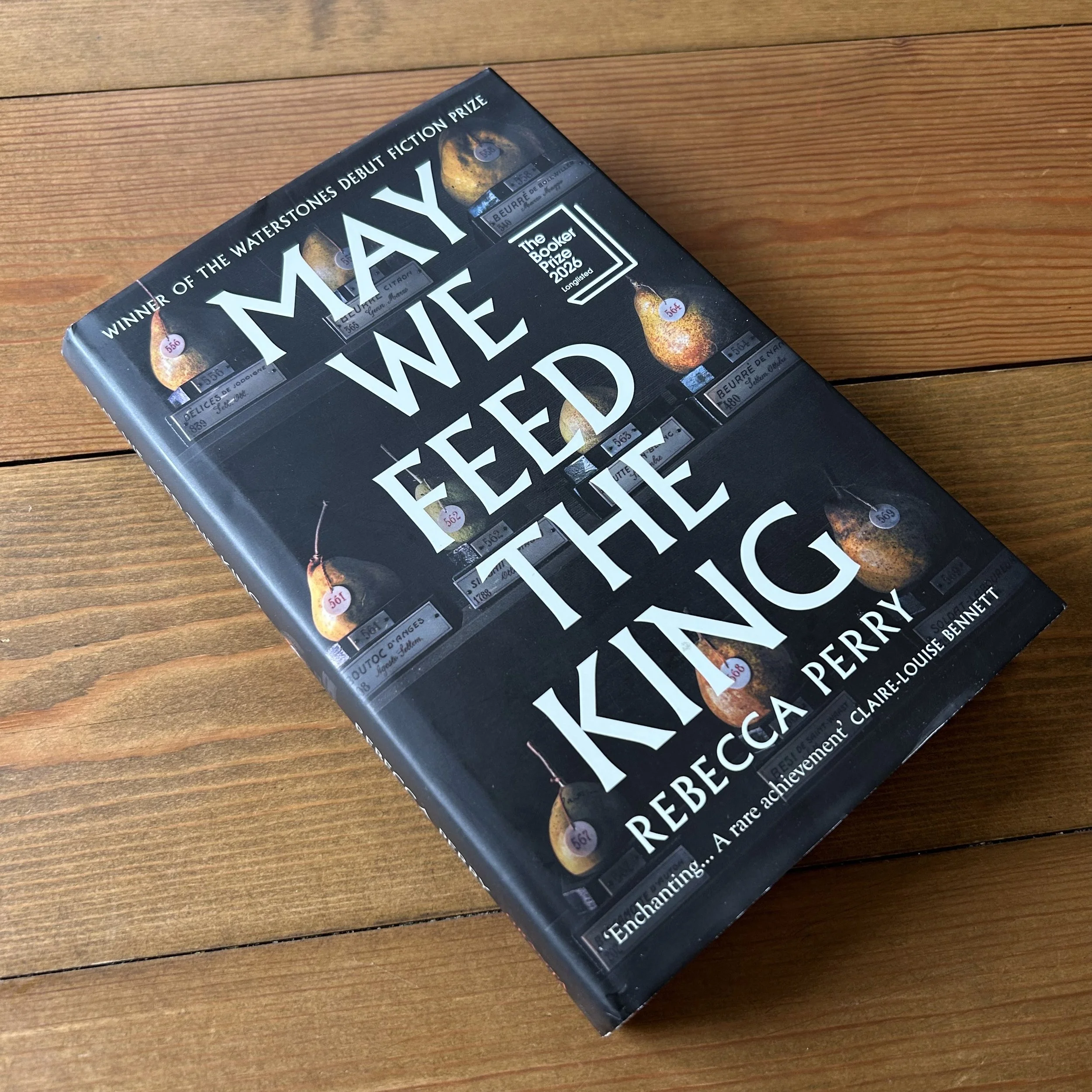
Why this one?
This one was my final read from the 2026 Booker Prize shortlist.
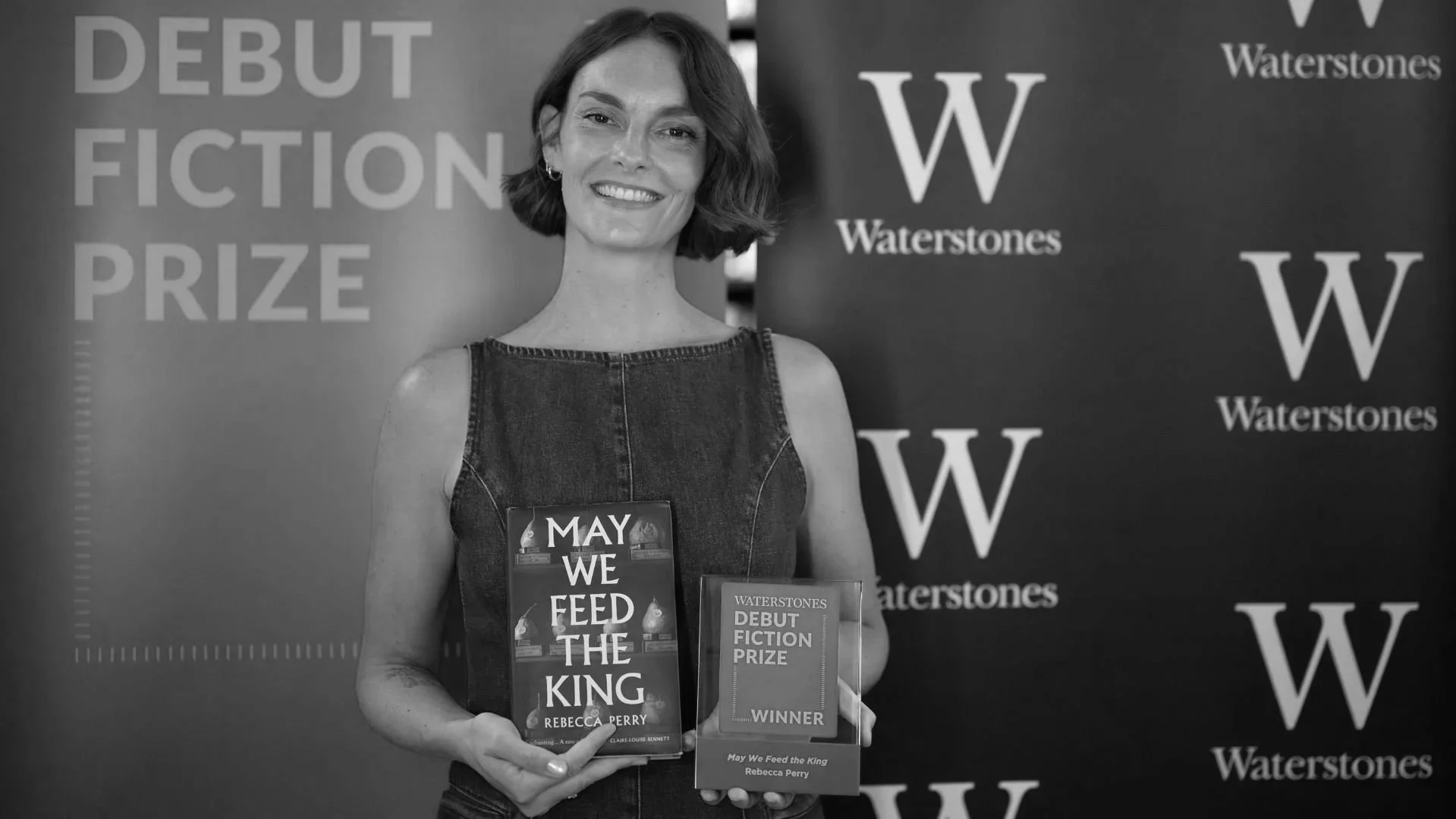
Rebecca Perry (1986- ; active 2011- ) is from Croydon, South London, UK. She studied creative writing at the Manchester Centre for New Writing, graduating in 2008. She has so far been best known as a poet, with her debut pamphlet Little Armoured published in 2011. Her debut collection, Beauty/Beauty (2015) won the Michael Murphy Memorial Poetry Prize as well as being shortlisted for several other notable awards including the T. S. Eliot Prize. Her second collection Stone Fruit followed in 2021, and she has since released the non-fiction book On Trampolining (2023). May We Feed The King is her debut novel, and won the 2026 Waterstones Debut Fiction Prize. She was named one of the 10 best debut novelists of 2026 by The Observer.
Thoughts, etc.
May We Feed The King is framed by the story of a present-day curator, who is tasked with preparing and dressing the private quarters and dining tables of a historic medieval palace for public display. Seeking distraction from the emotional emptiness of her personal life and a recent separation, she throws herself entirely into the material textures of the past. As she arranges hyper-realistic replica artifacts into tableaus of half-eaten replica meals and other evocations of the day-to-day reality of the one of the palace’s unheralded rulers. she becomes profoundly fixated on this King’s inner life.
The historical timeline, presented neutrally but likely an articulation of the curator’s imaginings based on her detailed research, follows this unenthusiastic and unnamed medieval monarch, who inherits the throne unexpectedly after the deaths of his two older brothers without heirs. The King displays little interest in exercising power or fulfilling traditional royal duties, infuriating his court with his inaction and lack of desire to empire-build or even to enjoy the trappings of royalty. The arrival at the court of the King’s cousin’s wife throws things into further disarray, with rumours swirling around the conspiratorial behaviour taking place between the King, his wife and this new arrival. The King eventually flees the court under mysterious circumstances, and a flash-forward sees his loyal young attendant reflecting on the unknowns of what may have happened to his former master.
The final section takes us back to the present day, where the curator finalizes her historical installation for an anniversary exhibition, and reflects on the impossibility of her desire to truly understand such lost history, but the importance nonetheless of attempting to do so, in spite of the palace’s modern-day owners’ desire for her to present a more palatable, dumbed-down (and cheaper to produce) version for their visitors.
This for me was another really strong entry on what feels like one the best Booker shortlists in recent years. It does a huge amount with what seems like very little. A short novel, with sparse prose and an absence of any character names or identifying historical or geographical context, it nonetheless manages to draw you in, not once but twice, into two very unique worlds. The contemporary story of the Curator gives us more than we ever thought we needed to know about the availability and relative quality of imitation foodstuffs - I’ll never walk around an installation in a historic building in quite the same way again - while giving us very little information about her own life and motivations. We understand that she is relatively unhappy in her private life, and throwing herself into this detail as a means of distraction and escapism.
She’s also somewhat iconic in terms of what she represents to anyone who has ever spent an obsessive amount of time on the creation of something of meaning - whether artistic or historical or otherwise - particularly in the face of demands to moderate this drive for richness and meaning in favour of the demands of capitalism: make something cheaper, quicker and easier to digest for a paying audience. Don’t be too subtle, too ‘clever’, and certainly don’t create unnecessary ambiguity. Give the people what they want, and to hell with any elevated notions of truth (or indeed beauty).
The King’s narrative is even more captivating. It works (more than works, really, excels) as a standalone piece, even without what the choice of this particular King (obscure, unpopular, forgotten) says about the Curator and the challenges facing her vocation in the modern world. This un-kingly King is a compelling creation, at odds with the many depictions of monarchs we’ve become accustomed to, all of whom (good or bad, successful or unsuccessful, famous or infamous) tend to have at least some clear interest in the benefits of their unique role in the world. As his courtiers repeatedly observe, they’ve happily dealt with incompetent monarchs for whom they can cover and take control, distracted ones who are only interested in the glittery trappings of their position and therefore happy to delegate the messy business of monarchy to their underlings, and of course the strong-willed ones who may overrule them but at least in doing so are doing something, making something happen.
The courtiers in some way play a similar role in this section to the palace’s owners in the present day - they’re mystified by complexity, desperate to take predictably big and brash actions that can’t be interpreted as anything other that what they are. They yearn for progress, action, movements that will lead to unspecified but likely mostly financial rewards. They’re faced with a King who seems to want none of this, has no desire to create conflict and inflict trauma on others for his own advancement, and is instead rather depressed by the fame his role has brought, and his inability to quietly engage with nature and perform such tasks as picking a flower without assistance. They have no understanding of the possibility of such a scenario, and begin to invent explanations for his behaviour, create ever-more elaborate rumours to explain what is ultimately an absence of anything to explain, and ultimately devise mechanisms to return things to a state of normality.
It seems that in the end the King takes matters into his own hands and flees, but the exact circumstances of this are left purposefully unclear by Perry (and by her Curator in the staging of this pivotal moment of his little-understood life). In exploring such a scenario, she asks questions about what we are doing when we try to explain the past, why the most interesting stories may have been buried for reasons known only to those who buried them, and why attempts to resolve these questions at a distance of centuries is doomed, futile and perhaps not even desirable. The best we can do is recreate their life and world in as much detail as is realistically available to us, create a picture (however impressionistic) of what may have been, and use that picture as a springboard for understanding something about what it was to be human in another era, to open up the past rather than to reduce it.
Score
9.5
Another great book, perhaps my overall favourite from an incredibly strong list. I’ve given a bunch of relatively high scores throughout, and I feel like ranking them does a disservice to some those nearer the bottom, which are all almost equally wonderful. But I think my ordering would look something like
May We Feed The King
The Things We Never Say
Black Bag
The Disappearers
John of John
The End of Everything
Had it made the shortlist, Switzy would have been at or near the top of this list, but never mind! Unusually it’s a year in which I wouldn’t be disappointed to see any of these great books winning the prize - all feel like worthy entrants to the canon in one way or another.
Like the sound of this one? Buy it at bookshop.org.
(If you click through and make a purchase, I may earn a small commission from Bookshop.org at no additional cost to you, which helps support local independent bookshops. I’ll only share these links for the highest rated titles on the site.
Next up
Likely a little break, or at least a slower pace of posting (not that I was exactly prolific before, I know!)