Why this one?
Continuing with the 2026 Booker shortlist.
Elizabeth Strout (1956- ; active 1982- ) was born in Portland, Maine, USA. She studied law, receiving her J.D. from Syracuse College of Law, as well as spending time at Oxford in the UK. Her first short story was published by New Letters magazine in 1982. She worked briefly in law and subsequently in teaching while working on her debut novel.
Amy and Isabelle was published in 1998 and was a critical and commercial success, nominated for the 2000 Orange/Women’s Prize (won by Linda Grant’s When I Lived in Modern Times) and the Pen/Faulkner Prize as well as being dramatized for a TV movie. Her third novel, Olive Kitteridge, won her the Pulitzer Prize for Fiction and was followed by a sequel Olive, Again in 2019. The first book was adapted for TV by HBO in 2014, with Frances McDormand in the title role.
In 2016 she published My Name is Lucy Barton, the first of her novels to feature her other famous heroine. It was longlisted for the 2016 Booker, and was followed quickly by Anything is Possible (2017) which features interlinked short stories set around Barton’s hometown. Oh William! (published 2021) was a more fully-fledged return to Lucy’s own story, continued in 2022’s Lucy By the Sea, set during the pandemic. 2024’s Tell Me Everything brought together characters from across Strout’s fictional world, including Olive and Lucy, and featured on the 2025 Women’s Prize shortlist.
Thoughts, etc.
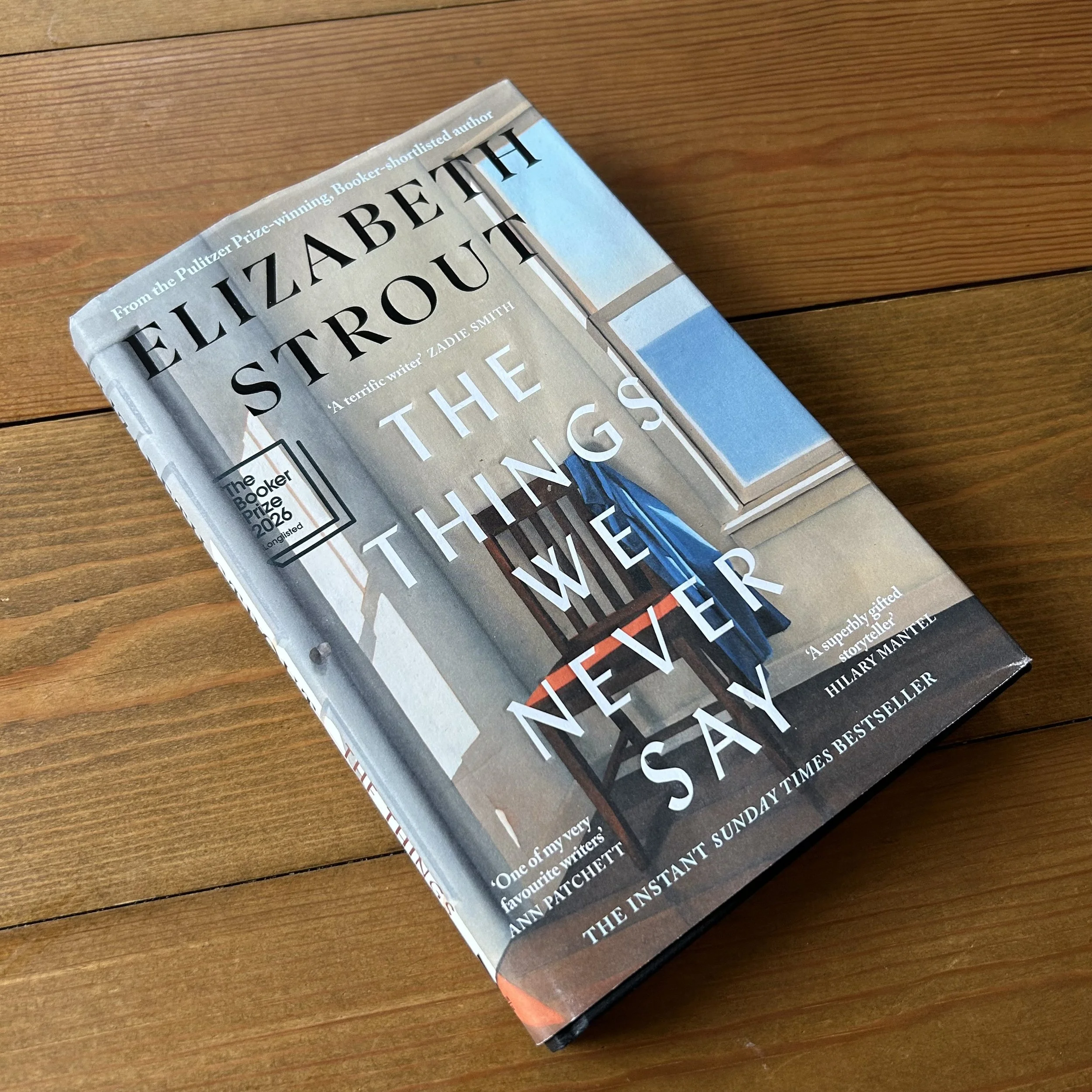
The Things We Never Say is set in Strout’s familiar New England, but with an entirely new cast of characters. It follows Artie Dam, a high school history teacher in his late 50s, in the months leading up to the 2024 US presidential election. Artie is married to Evie, a therapist who comes from a different social background, and they have an adult son named Rob. Some time prior to the events of the book, Rob was the driver in a car accident that killed his girlfriend; although he survived, he has been withdrawn and somewhat distant ever since. Artie himself is depicted as experiencing severe internal isolation, is emotionally disconnected from Evie, and is distressed by thoughts of the potential impact of the upcoming election. The weight of all of these concerns lead him to thoughts of suicide.
A keen sailor, Artie experiences an uncharacteristic accident in which he nearly drowns and is rescued by a man called Ken, who becomes an occasional dinner companion and confidante. His experience seems to at least temporarily rid him of his suicidal thoughts, but as he recovers he learns from Rob that he is not his biological father, a secret that Evie has deliberately kept from them both. This disclosure forces Artie to systematically re-examine the history of his three-decade marriage, his interactions with Evie, and the isolation that defined his relationship with his son after the car accident a decade prior.
As the narrative moves toward the 2024 United States presidential election, Artie engages with neighbours, colleagues, and students against a backdrop of increasing political division. While his career forms a point of relatively stability, in which he is able to continue to act as a role model for many of his students (particularly some of the more troubled and isolated of them), he begins to suffer more signs of mental decline, including developing a tendency for kleptomania. He is unable to bring himself to broach the subject of Evie’s deception with her, and their relationship continues to decline, though at the same time his connection to Rob seems strengthened. He learns that his new friend and rescuer Ken is a Trump voter, but continues to see him and avoid the subject of politics, seeing him as fundamentally a good person regardless. Nonetheless, the combination of the eventual national political outcome and the tension caused by his family revelations makes Artie’s disconnection from the world ever more pronounced, and when these issues lead to the end of his beloved career, he declines further and eventually dies (of natural causes), with the book concluding with various characters gathered at his funeral.
Following the fan-pleasing retrospective of Tell Me Everything (a kind of Avengers Assemble for fans of gentle psychological lit-fic) it’s great to see Strout starting with a relative blank slate, not deviating too far from her usual geographical terrain or exceptional prose stylings, but bringing in a range of typically engrossing new characters and using them to tackle, with typical subtly and deftness, the prevailing concerns of our time. Predictably, on a line by line level, it’s a joy to read. It’s a short book, but one that’s so beautifully written that I found myself taking it purposefully slowly, savouring how much Strout manages to say with so few words and so little in the way of ornament.
The way it tackles the re-election of Trump is an obvious highlight. For some, it might be almost too subtle and not sufficiently damning, but for me I think it achieves much more by handling it in this slightly more oblique fashion. While the man himself is never named, we are left in no doubt as to who is the source of anxiety and doom that hangs over the book’s pages. Artie is also brilliantly chosen as the lens through which we see this story unfold. As a history teacher, he’s fully aware of the potential longer-term consequences of many of the early signals being given out by the incoming regime, and as even vaguely well-informed readers we are able to share his concerns without them ever needing to be fully stated. He’s also an evident ‘good guy’, keen to see the best in everyone and everything, and shown repeatedly as not seeking to cast judgement on anyone, regardless of their beliefs. While some at certain ends of the political spectrum might be keen to disprove his apparent neutrality, for the book’s likely readership, I think it’s very clear that we could ask more no more impartial a guide to these polarised times.
Artie’s sense of isolation, even from those he is very close to, however, is also crucial. This allows Strout to explore the subtly devastating impact of distressing political developments at an interior level. While we may often focus on the visible, and often horrifying, physical manifestations of such regimes and their impact on the most disadvantaged and marginalised, the broader psychological impact of such developments on the average moderately well-informed individual who has seen this kind of thing before and can therefore foresee where it might be going, and particularly on those with existing mental health vulnerabilities (very clearly including Artie, despite his outward projections as a well-liked normal sort of guy).
In the course of the book’s events, Artie repeatedly learns about secrets that people he know keep, the titualer ‘things never said’, most obviously Evie but also smaller cases such as that of Ken’s political affiliations. As a man primed not to judge, and to thing the best of those around him, these revelations chip at Artie’s resilience, ultimately (we suspect) proving too much for him to bear. Artie’s choice in both of those cases is to keep quiet and avoid conflict, an honourable choice in some senses and one that many will make on a day to day basis. Both situations highlight that it is possible to co-exist with other ostensibly decent people, but with the cost of never being entirely sure what lies behind that ‘decent’ exterior. For a man like Artie, there is the implication (again never explicit) that this has the effect of weakening his belief in the fundamental goodness of humanity, and ultimately in himself. The book’s power lies in asking us to consider the impact of this kind of mental adjustment on millions of people at a societal level.

Score
9.5
Rather wonderful stuff. This is a really strong shortlist in my opinion. I have a feeling that in the final decision-making process this might suffer by comparison to some of the more obviously boundary-pushing or attention-grabbing titles on that list, but for me it’s right up there as one of the smartest and most quietly devastating books I’ve read in some time.
Like the sound of this one? Buy it at bookshop.org.
(If you click through and make a purchase, I may earn a small commission from Bookshop.org at no additional cost to you, which helps support local independent bookshops. I’ll only share these links for the highest rated titles on the site.
Next up
May We Feed The King