The End of Everything (2026)
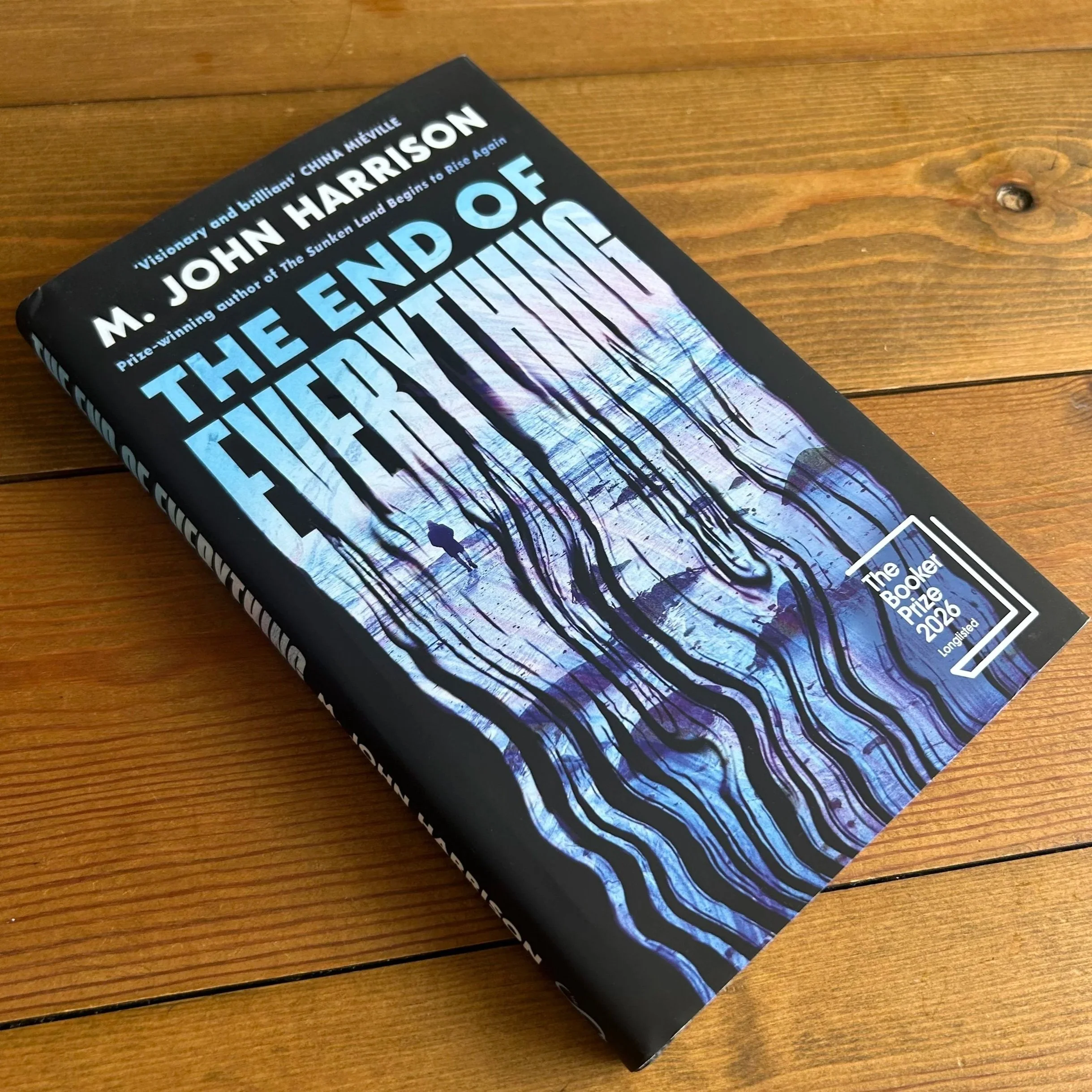
Why this one?
Continuing with the 2026 Booker shortlist.
Michael John Harrison (1945- ; active 1966- ) was born in Rugby, Warwickshire, England. He left formal education at the age of 18 and moved between jobs, including time as a student teacher, a clerk for the Royal Masonic Charity Institute in London, and was later books editor for the magazine New Worlds between 1968 and 1975. His early short fiction began appearing in print in 1966, followed by the publication of his first novel, The Committed Men, in 1971. Over a career spanning more than five decades, Harrison has authored over twenty books, encompassing novels, short story collections, and non-fiction.
Throughout his writing career, which has often focused on a literary take on science-fiction and fantasy genres, Harrison has produced several notable multi-book sequences, including the Viriconium series (1971–1984) and the 2000s’ Kefahuchi Tract trilogy (Light, Nova Swing, and Empty Space). His standalone works include novels such as the semi-autobiographicalClimbers (1989, the start of a period in which he temporarily abandoned science fiction and explored other ) and The Sunken Land Begins to Rise Again (2020), as well as an “anti-memoir” titled Wish I Was Here (2023). His writing has received numerous honours, including the Boardman Tasker Prize for Climbers, the Arthur C. Clarke Award and Philip K. Dick Award for Nova Swing, and most recently the Goldsmiths Prize for The Sunken Land Begins to Rise Again. He served as a judge for the Booker Prize in 2022 (won by The Seven Moons of Maali Almeida and sadly not by The Trees) and was elected as a Fellow of the Royal Society of Literature in 2025.
Thoughts, etc.
The End of Everything is set in a near-future Britain in which some disaster, or combination of disasters, seems to have occurred, and yet its inhabitants continue to attempt to maintain some semblance of their old routines and rituals. Infrastructure has mostly collapsed, the political landscape is dysfunctional, Europe appears to be ‘missing’ and Britain is shadowed by a vaguely understood but seemingly ongoing crisis associated with an enigmatic, ostensibly “alien” presence referred to as the "iGhetti." The primary narrative follows Phillip Tennent, a man living on the Kent coast who makes his living as a beachcomber, searching the shoreline for washed-up objects of potential value. Early in the book, Phillip discovers an unusual ‘artefact’, which while compared to organic matter and possessing infant-like qualities, it is generally ill-defined other than by its potential sale value, and Phillip initially focuses on trying to find a buyer for the ‘object’.
As Phillip moves around the local area, the artefact grows rapidly and gradually begins to develop a form approximating that of a human and to mimic human behaviours and speech. Throughout his journey, Phillip encounters various indifferent or resigned locals, and his interactions with the object, alongside his fading relationship with his partner, Alice, form some sense of ‘story’ in a generally mysterious narrative. Running alongside Phillip's journey is the storyline of his elderly aunt, Marnie, a former artist dealing with the mental strains of aging, potentially dementia. Following a sudden, jarring act of violence, Marnie embarks on her own erratic journey, later with the more developed artefact becoming her travelling companion. While there are developments of sorts through the book, there is no clear resolution to its setup. It very much leaves the reader to draw their own conclusions about what may or may or may not have happened, still be happening, or be about to happen in its strange and hugely atmospheric world.
This is certainly one of the more ‘challenging’ reads to have made it onto a Booker shortlist in recent years. Putting my cards on the table, it fits into a category that I’ve often dismissed as and when they do appear - books that go beyond merely ‘resisting easy interpretation’ and into the realms of ‘wilfully alienating the reader’. And I have to say that I wrestled throughout this one with the same thing. If you (like me) tend to prefer to have at least a vague idea of what’s going on, some general sense of what’s trying to be said, and, y’know, some adherence to basic laws of reality and representation, then this book is probably not going to be a straightforward winner. And yet…
And yet somehow this kept dragging me back in. First and foremost, I think, because of its atmospherics. It brilliantly conjures a kind of woozy, mist-enfolded half-reality, a recognisable near-future Southern England but one that consistently sees its foundations shifting, never allowing us to settle on a simple sense of place or time. Many reviews have flagged its dream-like nature, and I think that’s totally valid, though perhaps leaning more towards the nightmarish in places. The artefact begins as a kind of blob of whatever, becomes gradually more alien, and then reaches a peak of shudder-inducing creepiness as it enters the uncanny valley of almost-humanness. An otherwise amiable-seeming elderly woman on several occasions slips into casual extremes of violence. Characters look at London from a distance and observe a hyper-concentrated miltary campaign targeted on the financial district. None of it makes a lot of sense, but it is artfully done, written with the perspective-shifting wrongness of cubism, the misty haze of impressionism, and other such remarkable transpositions.
As I say, trying to wrestle straightforward ‘meaning’ from all of this is probably a fools errand, but there is certainly plenty of surface off of which thoughts can be bounced. What seems obvious is that the focus is less on what the confluence of disastrous circumstances that have occurred is supposed to represent, and more on the response of the population to it - notably in the attempts by most of its inhabitants to ‘keep calm and carry on’ in the face of a world that’s no longer making any sense. The conditions that brought about those circumstances don’t need to be a simple allegory for any one thing in particular, and can stand for any number of ills (real or potential) afflicting the modern world. We can certainly draw inferences though, indeed many of them: the evolution of the artefact might point us towards contemporary thinking about generative AI; the endless (Orwellian) war with no meaning to any number of similar ongoing conficts; the ‘missing continent’ to (fairly obviously) Brexit; the locus being the City of London to late-capitalism; and the pervading sense of doom to the one all-encompassing issue of our times, the climate crisis.

Score
8.5
While I totally get why it might frustrate many readers (it did me, to a large extent), it’s ultimately one that I think will stick in my mind for a while, and keep generating thoughts and ideas as a result.
Like the sound of this one? Buy it at bookshop.org.
(If you click through and make a purchase, I may earn a small commission from Bookshop.org at no additional cost to you, which helps support local independent bookshops. I’ll only share these links for the highest rated titles on the site.
Next up
The Things We Never Say.