The North Road (2025)
Why this one?
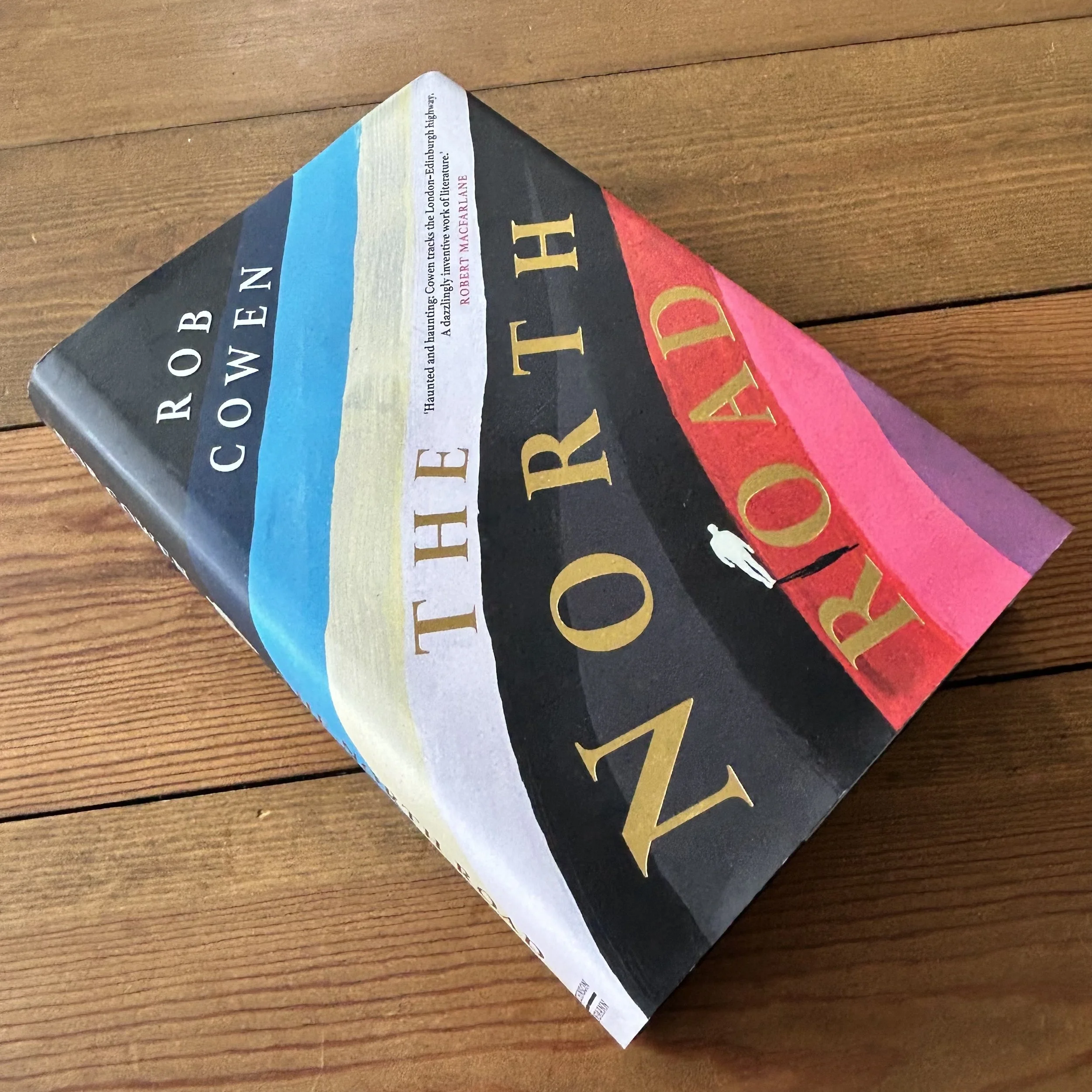
I think I initially noticed this one by means of a recommendation from Benjamin Myers, which always feels like a safe place to start. The subject was also appealing: I’m fond of maps, psychogeography and explorations of my home country. I grew up not too far from the titular road (my hometown’s name crops up a couple of times in passing) and spent many years subsequently in North London, at least vaguely near its origin. It also has a beautiful cover, doesn’t it? No shortage of reasons, then, to check this one out.
Rob Cowen (1976- ; active 2011- ) was born in Ilkley, West Yorkshire. After graduating from the University of Leeds, and playing in various bands, he worked as a journalist, writing on nature and travel. He has contributed to the New York Times, the Guardian and the Independent and written radio programmes for the BBC. His first book, Skimming Stones (2012), received the Roger Deakin Award from the Society of Authors. He is also the author of Common Ground (2015), an examination of a square mile of land in Harrogate, North Yorkshire. This work was shortlisted for the Wainwright Prize, the Portico Prize, and the Richard Jefferies Society Award, and was voted one of the nation’s favourite nature books of all time in a BBC poll. A version of it produced in combination with several folk musicians also hit the stage in 2016. He has also published a volume of poetry, The Heeling (2021).
Thoughts, etc.
The North Road is one of those books that’s very difficult to categorise. Superficially, it’s fairly straightforward: a non-fiction book about Britain’s ‘Great North Road’, a 400 mile stretch that has existed in some form or other since Roman times, now known (for the most part) as the A1(M) motorway. Yet from its earliest pages, it’s clear that it’s a little more complex than that. We begin by encountering Cowen in something of a career rut, having recently become a father for the second time. He’s encouraged by his own father to get out a bit, and this leads him, under the precept of a journalistic story of some sort, to join an archaelogical dig somewhere in the vicinity of the A1 near Catterick, where he soon ends up unearthing long-forgotten remains and beginning to combine several threads into the idea for the book that we end up holding in our hands.
It’s rightly been described as kalaedoscopic in scope, but there seem to be at least three linked threads that spin off from this originating incident. First, the proximity to the road itself unlocks the idea of that ‘Great’ thoroughfare as a structuring vehicle for an examination of the history of the country it straddles. The unearthing of human remains sparks several of the book’s other major themes - mortality, and a deeper quest for purpose and meaning that this journey might help its author explore. And finally the connection to family that inspired the visit to the dig is far from insignificant - overlaid across all of those themes is Cowen’s own family - from the meaning and joy found in his own two children, to a look back at his teenage abandonment by his own father, explorations of his great-grandfather’s own travels up and down the North Road, and the ups and downs of his life (from tragedy to schmoozing with Burton and Taylor in his London years), and eventually a grander sweep back in time to the discovery of another long-lost buried soul who turns out to be an ancestor.
It’s interesting, beyond this, to think about the book’s many different modes and how successful it is at effortlessly switching and sliding between them. As it gets into its stride, it’s dominant mode seems to be a travelogue, albeit an interesting one as Cowen walks a large part of the Road’s early miles from London to the home counties, accompanied by his seemingly less contemplative soldier friend known only as A. In these sections, there’s an enjoyable but not entirely unexpected blend of history of the Road’s origins, various tales of famous highwaymen and suchlike, and reportage of the pair’s interactions as they navigate the often uninspiring concreted suburbia that characterises this stretch of road. Still here there are highlights, both weird (the archaic May-day celebrations they come across towards this section’s end) and touching (Cowen’s recollections of a personal connection to the Hatfield rail disaster, as they pass its location).
This latter point is one of many early deviations into something more closely approximating memoir or family history. A sort of psychogeographic take on ‘Who Do You Think You Are’. These are clearly the book’s heart, and cover a huge amount of ground both in terms of Cowen’s own ups and downs and those of his relatives. In every case there’s a connection to the Road, never forced, even where the extent to which his family’s history seems magnetically attracted to the Road to a point that stretches even Cowen’s own sense of coincidence. Perhaps most moving is the juxtaposition between the moments of pure tragedy (the death of a young employee of his great-grandfather; a horrific mining collapse that also impacts young workers) with the hope and inspiration Cowen finds in the present day with his own young family, which is always a joy to return to.
On top of all of this, there are sections that jump straight into fictionalised recreations of historic events. Some of these bring to life relatively well-known characters, but mostly they focus on events either centred on or relevant to the ordinary folk that have lived alongside the road over its many centuries. These are generally wonderfully done, lending the book an immersive feel that a mere recounting of the same events would not have done. Admittedly, some of them are somewhat hard to penetrate, generally appearing as they do somewhat unannounced and only then being explained in retrospect. This works for the most part, and hits exceptional heights where the fictional narrative is presented as a contrast to the more studiously historical take with which it is followed up, such as in the recounting of the racist takes on a locally famous boxing match, and that of a murder of a supposed drunken man along the Road’s route. There are a couple of these sections that maybe drag a little, but they do draw you in and offer a sense of time-travelling wonder that a more straightforwardly factual telling would have missed.
Something else that I enjoyed finding threaded through the whole book (yes, there’s still more!) was a layer of contemporary commentary on the years over which the book was written. From genesis to completion seems to have taken Cowen at least a decade, yet the ‘present day’ seems to retain its tense throughout, which makes for an interesting reading experience, as experiences of Brexit’s separation and isolationism sit alongside historic tales of building connection; Covid intervenes to prevent Cowen’s movement along the road, and is juxtaposed with fictionalised accounts of previous plagues; and the collapse of the climate raises its ugly head, itself a manifestation of the recurrent theme of all roads having to have an end.
Just sketching down these somewhat random thoughts about the extensive and multifaceted contents of this excellent book doesn’t really do it justice. It suggests something messy (it is, but only in the sense that life is) and complex (similarly so, but almost always a joy to read in the moment). If you come to this book expecting a simple history or travelogue, you’ll definitely be surprised by how much more than that it contains. It certainly works on this level: you still come to its end feeling like you’ve been on that journey with its author, traversing Britain’s length as well as its history and picking up what makes each stretch of that road unique. But it’s the universal themes (mortality, the importance of family, that elusive idea of ‘Britishness’ and what - if anything - it means) that are expressed through Cowen’s own exploration of his life and family history, that elevate this into something truly magnificent.

Score
9
Highly recommended reading. Like the road, it covers a huge amount of ground, winds its way through diverse landscapes, has no clear beginning or end, and often deviates away from its main path. But all of that, of course, is its beauty.
Like the sound of this one? Buy it at bookshop.org.
(If you click through and make a purchase, I may earn a small commission from Bookshop.org at no additional cost to you, which helps support local independent bookshops. I’ll only share these links for the highest rated titles on the site. )
Next up
TBC.