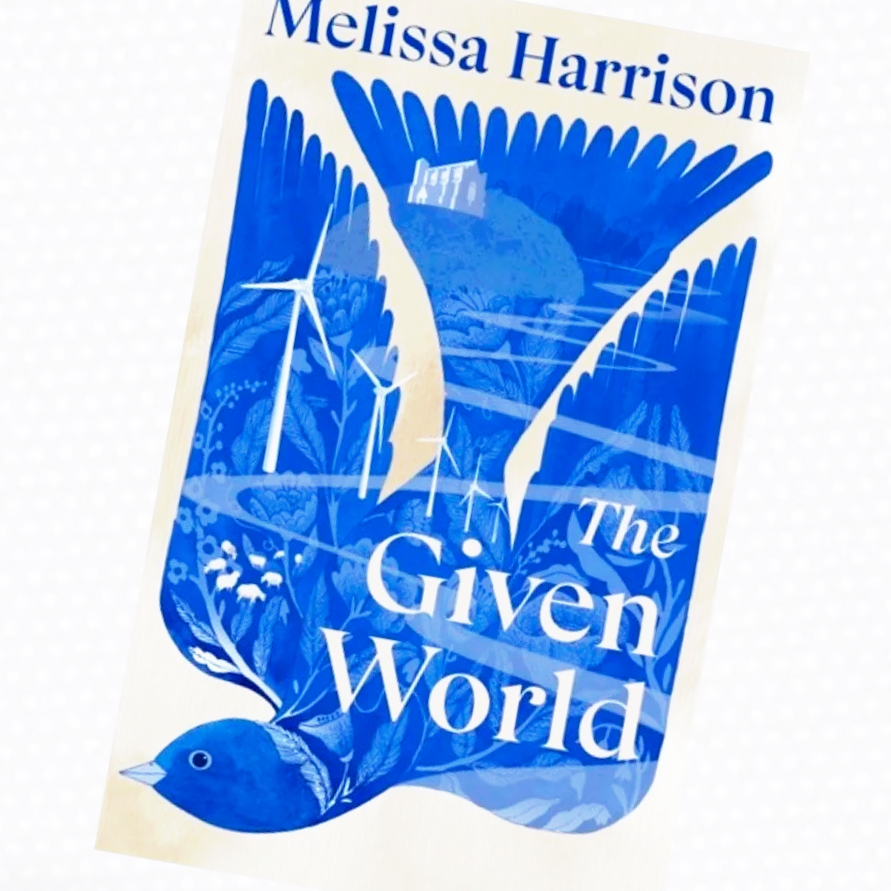
The Given World (2026)
Why this one?
Some glowing endorsements on Netgalley from the likes of Sarah Moss and Francis Spufford convinced me to check it out.
Melissa Harrison (1975- ; active 2015- ) was born in Surrey, England. She studied English at Lincoln College, Oxford and after graduating in 1996 worked as a freelance magazine subeditor, as well as writing for the likes of the Guardian and the Times (contributing the ‘Nature Notes’ column for the latter).
She published her debut novel, Clay, in 2013, and was shortlisted for the Costa Prize and longlisted for the Women’s Prize for Fiction for her second, 2015’s At Hawthorn Time. Her third novel, All Among the Barley (2018), won the European Union Prize for Literature. She has written extensively on the subject of nature, both in her fiction and in non-fiction works including Rain: Four Walks in English Weather (2016) and The Stubborn Light of Things (2020), the latter spun off from a podcast she began during the Covid lockdowns. She has also written books for children, including the Moss series, beginning with By Ash, Oak and Thorn (2021). Her books have also been longlisted several times for the nature-focused Wainwright Prizes.
The Given World is her fourth novel and is due via Random House / Cornerstone in May 2026. Thanks to them and Netgalley for the ARC.
Thoughts, etc.
The Given World is set in a rural community in the fictional village of Lower Eodham, in the Welm Valley in southern England. It’s set in a modern-feeling world, albeit one in which an unnamed (but very Climate Crisis-y) threat is more imminently looming. Its chapters take turns in offering the perspective of a range of characters who make up the village, each dealing with their own personal issues, from tragedies to minor conflicts, alongside Harrison’s documenting of the unravelling of the social and environmental constructs that held the village and its community together.
It’s a book that sets its stall out fairly quickly in terms of its roots in the natural world, with some richly descriptive early passages before we start to get into the human stories which make up its individual chapters. We’re soon introduced though to Clare Grey, a long-time resident and pillar of the community, living in a converted priory which has been in her family for generations. With her acquisitive father now dead, and her sister long since relocated to London, she’s now the steward of the property. Through the book, Clare learns of some less savoury parts to her family’s history and its impact on the land and community, and it’s also revealed that she is terminally ill. In both senses, she seems more widely emblematic of the sense of decay and impending doom that hangs over the valley. There’s an elegiac quality to her story and that of the community as a whole, a sense of innocence lost and corrupted by man’s competitive urges in the modern era.
While Clare’s story anchors the book, each chapter takes us into the inner world of a different character. We find the tragic aging figure of Alan Jope, the last of an even longer history of landowners in the area, now reduced to a fairly pitiful existence in a version of the valley that he barely following land-grabbing injustices and the death of his brother. Elsewhere, an elderly female resident narrowly escapes death after a fall, a builder suffers from vertigo while going about his work on a roof, ‘incoming’ rich residents struggle to integrate, and various younger residents grapple with the eternal dilemmas of coming of age in the middle of nowhere: to leave for a life of promise elsewhere, or stay and commit to a relatively risk-free but likely very dull existence, following in the footsteps of ancestors in a diminished version of the world in which they thrived.
Throughout, the modern world’s intrusions are contrasted with folkloric images from the region’s distant past and the simple decency of the older residents (who are, in one way or another, fading in influence) is set against the capitalistic drivers of incomers (not all of them that recent) who prioritise short-term profit over any attempt at sustaining harmonic balance within nature, community or family. Petty disputes continue in the foreground while in the background all of the residents have a sense of dread (generally haunting their dreams) of something not quite right with the world. Next to a sign bearing the village’s name sits a dead badger’s corpse - recently demised at the book’s start, merely a semi-buried collection of teeth and bones by its end.
It’s a book that presents a compelling and unsettling vision of a familiar world rendered increasingly unfamiliar. Ultimately its message - presented with impressive subtlety but clear nonetheless - is one of the urgency of coming together to combat the many forms of decay being inflicted on our world (‘given’ to us, and therefore by inference easily taken away), all ultimately rooted in the competitive individualism and consequent societal fragmentation that characterise late capitalism and particularly its present technology-dominated manifestation. The novel is far from conclusively optimistic about the possibility of such a solution, but in its characters’ banding together in moments of tragedy, and its final pages’ nods towards a collective voice over the individual, it hints that hope has not been entirely extinguished.
Score
9
A beautiful and sad book that I’d love to see cropping up on some of the major prize lists this year.
Like the sound of this one? Buy it at bookshop.org.
(If you click through and make a purchase, I may earn a small commission from Bookshop.org at no additional cost to you, which helps support local independent bookshops. I’ll only share these links for the highest rated titles on the site. )
Next up
Looking forward to reading Glyph by Ali Smith, the sister novel to her recent Gliff.