The Gallows Pole (2017)
Why this one?
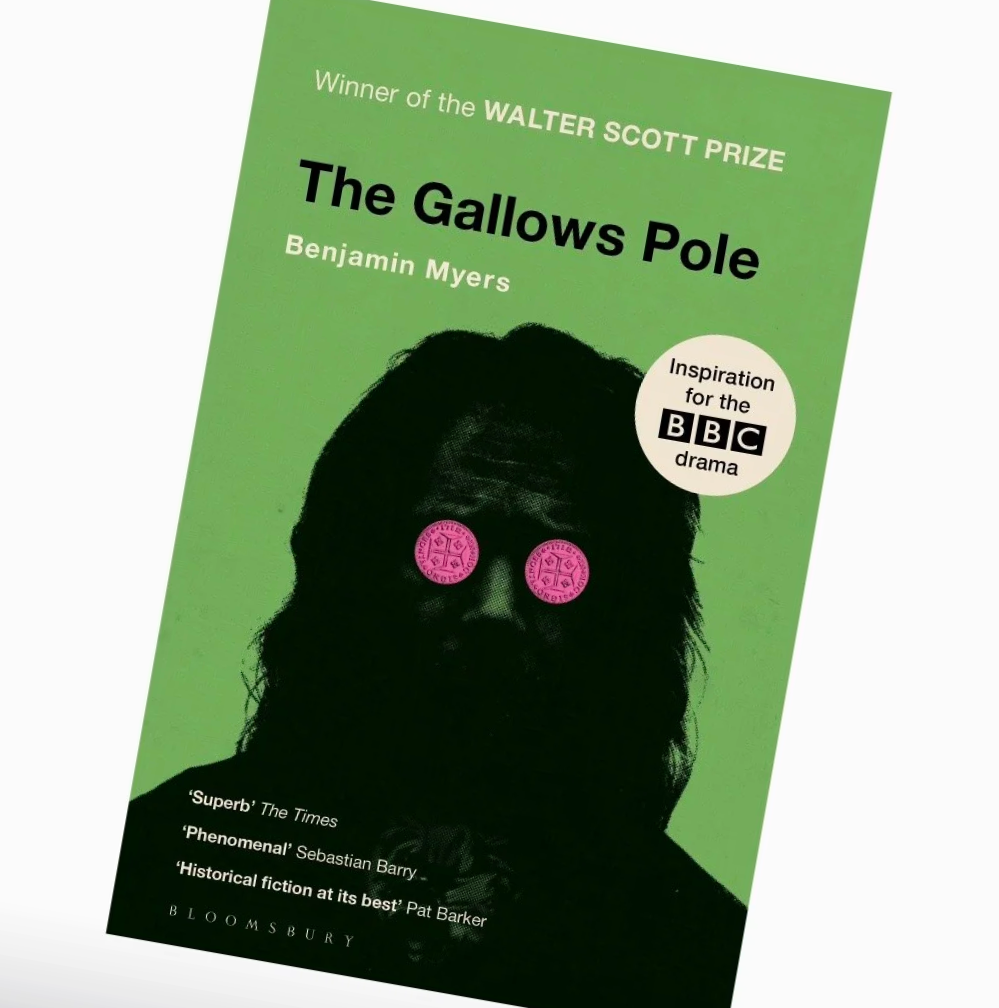
Every now and then I like to fill in some gaps by Benjamin Myers, and given that this might well be his most well-known book (in the UK, at least) due to its BBC adaptation, I’m long overdue getting to this one.
Benjamin Myers (1976- ; active 2004-) was born in Durham, England. In his teens, he was a member of the local punk band Sour Face, and began writing for the weekly music paper Melody Maker. Alongside his journalism, he also published books on the likes of John Lydon, Green Day and The Clash. He published his first novel, The Book of Fuck, in 2004, but it was his second Richard: A Novel (2010), about missing Manic Street Preachers member Richey Edwards, that brought wider attention.
His third novel, 2012's Pig Iron, won the inaugural Gordon Burn Prize, and this, his fifth, The Gallows Pole (2017) won the Walter Scott Prize for Historical Fiction. The latter was also the inspiration for a BBC TV series by Shane Meadows (This is England) that aired in 2023. His beautiful 2019 novel The Offing is being adapted as a film by director Jessica Hobbs (Broadchurch, The Crown) starring Helena Bonham Carter. 2023’s Cuddy won the Goldsmith’s Prize and is generally incredible. He followed that book with the much lighter in tone but equally enjoyable Rare Singles (2024) and most recently the brilliantly bonkers Jesus Christ Kinski (2025). Alongside his literary novels he has also published crime fiction, short stories and poetry. He is married to fellow author Adelle Stripe.
Thoughts, etc.
The Gallows Pole is a historical novel set in 18th century Yorkshire. It focuses on the true story of the Cragg Vale Coiners, a ragtag bunch of local men under the leadership of '“King” David Hartley who scrape a living together by “clipping” coins to melt down and produce new forgeries. The book is set on the cusp of industrialisation, in the dying days of an era when a charismatic man could hold effective dominion over a valley, in a relatively closed community maintaining a form of isolation from the rules and laws of the land. The exciseman William Deighton enters as an outsider, vowing to take down Hartley and his hugely successful enterprise. As the web closes in on the Coiners, in the background cotton mills are rising, turnpikes slicing their way through the countryside, and a way of life being lost to history.
Myers’ book brings this lost world to life in vivid and colourful detail. Hartley, as rendered by the narrator and in alternating sections of his own prison writings, is a compelling character, dominating the area through a mixture of his comparitively more advanced intellect, his skills in self-mythologising, and a sense of spirtual forces guiding him that imbue him with a fierce confidence. In the narration (the myth) he is often tough to like - violent, capricious and capable of exacting humiliation on any of his subordinates who fall out of line - but nonetheless evidently a leader for a reason, with most of the supporting Coiners coming across as bumbling clueless oafs by comparison. In his own words, he becomes somewhat more sympathetic (if still entertainingly crude), revealing both some of his vulnerabilities and also highlighting his quasi Robin Hood esque motivations, robbing the rich with the help of his local community to ensure that local community can help itself, and ultimately survive. His capture and therefore failure is acknowledged in a roundabout way by Hartley as a wider failure in society.
While the book’s surface appeal is certainly in its evocation of that lost world in all of its filthy, stinking, wart-laden reality, and bringing to life the complex character of Hartley, as well as in its well-constructed plotting of his downfall (page-turningly compelling despite us knowing its inevitable conclusion, almost regardless of familiarity with the historical source material), there’s far more going on beneath the surface. For me the most impressive aspect of The Gallows Pole is its framing of the historical moment as a pivot-point at the beginning of the journey towards industrialised capitalism. Hartley clearly isn’t a straightforward hero: there’s no doubting that however noble some of his intentions towards his community may be, he’s nonetheless seemingly primarily motivated himself by the accumulation of wealth, the burnishment of his reputation and the betterment of his and his family’s lifestyle as a result. But he’s also representative of the ways in which his community based society at the very least offers its inhabitants to opportunity to sustain themselves, admittedly by criminal methods but in a form of ‘every man for themselves’ structure in which they can at least find ways to better themselves. As the mills rise, Hartley can foresee the alternative: capitalist enslavement, in which the same men will be given legitimate work, but work that will only ever serve to line the pockets of their masters. Hartley himself may have been a kind of feudal tyrant, but his subjects at least had a form of agency.
Ultimately though Hartley’s attempt to sustain this way of life as rebellion against the arrival of outsiders and the looming threat of industrialisation is a doomed one. Like most idealistic movements, it is undone by inevitable corruption and the centre of its project, and in overreaching beyond its sustaining principles ultimately accelerates its own destruction and the rise of its replacement. It’s a book with a great line in moral ambiguity, but also one that recognises the futility of the fight - what’s coming is simply too big to fail, and this emerging moment will not be the last time forces attempting to counter its advance fail due to internal division and the corruption of their leaders. Hartley may be a good man to have fighting one’s fight while the going is good, his unshakeable and quasi-mystical sense of mission elevating everyone in his circle, when a force such as his eventually crashes back down to earth, it takes everything in its path with it.
Score
9
Typical brilliance from Myers. This is the fifth book of his I’ve read now and every one is completely different (aside from the general unifying factor of some form of starring role for Northern England) . I can very much see why this one was such a big deal and won awards. Maybe not my absolute favourite of his, but still supremely memorable.
Like the sound of this one? Buy it at bookshop.org.
(If you click through and make a purchase, I may earn a small commission from Bookshop.org at no additional cost to you, which helps support local independent bookshops. I’ll only share these links for the highest rated titles on the site. )
Next up
Time for some selections from this year’s Booker longlist!