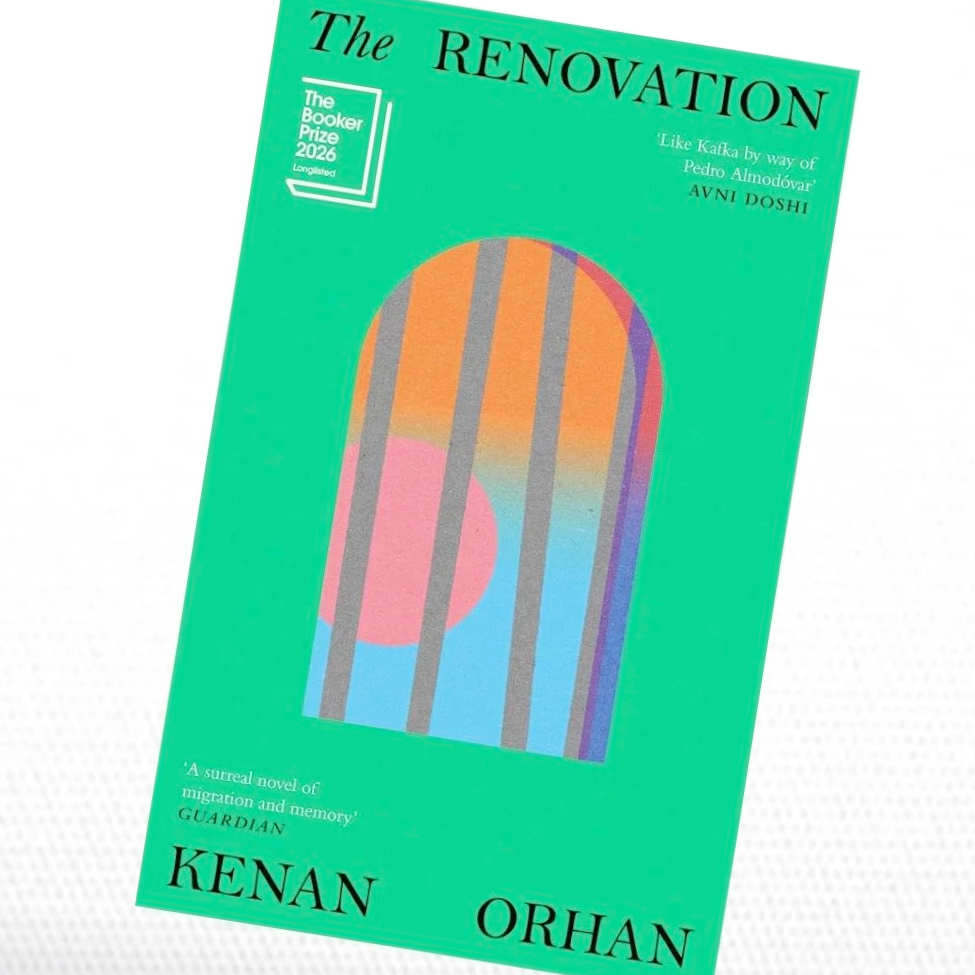
The Renovation (2026)
Why this one?
I’ve been some selections from the 2026 Booker Prize longlist . This was my last choice before the Shortlist (on which it doesn’t feature) was announced.
Kenan Orhan (1993- ; active c. 2015- ) was raised in Overland Park, Kansas, USA. He grew up in a half-Turkish household and spent childhood summers visiting family in Turkey. Despite maintaining this connection, he has described how his family's self-imposed exile and distance from Turkey due to the country's political climate deeply shaped his identity and writing. He earned a BA in History and English from Kansas State University in 2015 and later received his MFA in Creative Writing from Emerson College in Boston. He currently lives in Kansas City, Missouri, where he teaches creative writing.
He was initially known for his short stories, releasing his first collection I Am My Country in 2023, a finalist for the PEN/Robert W. Bingham Prize and was longlisted for The Story Prize. The Renovation is his debut novel, expanded from a short story (originally published in The Atlantic), and in addition to its Booker nod was also recently longlisted for the 2026 National Book Award.
Thoughts, etc.
The Renovation follows Dilara, a Turkish woman living in self-imposed political exile in a quiet coastal village in Salerno, Italy. Unable to find employment in her field, she has dedicated herself to the care of her aging father, who is suffering from advanced dementia, and at the start of the book is in the process of installing a second bathroom in her apartment to accommodate his needs. After weeks of secretive construction hidden behind tarpaulins, the contractors pack up and leave. Instead of the modern en-suite bathroom Dilara was expecting to return home to, she finds instead a fully functioning, replica Turkish prison cell.
The cell acts as a portal directly back to her homeland. Behind its walls, she hears Turkish guards, experiences the sounds and smells of home, and eventually realises (as it begins to fill with other female inmates) that the space connects to a real prison in Istanbul. As her life in Italy unravels (her anxiety-ridden husband can’t cope with the development and flees, while her father’s health worsens, and her finances struggle) Dilara finds herself retreating more and more into the impossible cell, which acts not just as a physical portal to her old life, but as a spark for the revisiting of old memories in which the personal and political are inextricably linked. Events covered in these flashback notably include those focused on the upheaval in Turkey around the failed coup d'état against President Recep Tayyip Erdoğan and his government in 2016, and the ongoing purges and clampdowns that followed, as well as the consolidation of his rule in the 2023 elections.
I thought the premise of the book was fascinating and was expecting a lot from it. Initially it worked very well for me: I loved the early absurdity of the cell’s emergence and the extremely Kafka-esque conversations with the contractors (who simply say that Dilara signed off on it so it must be fine). By the end of the book, though, I did feel mildly underwhelmed by its conceptual flourish, which ultimately for me felt like a concept worthy of a short story but one that lacked development in the broader expanse of a novel.
I think to some extent that is the point - that the cell’s arrival doesn’t herald anything momentous for Dilara or her family, but simply expands (as the prison does) to take up more and more of Dilara’s life, both as an escape from her present reality (itself a form of imprisonment in which she is unable to move forward in her everyday life due to the demands of caring for her ailing father) and as a method of engaging with conflicting emotions around exile from her homeland (almost, I suppose, an exile version of ‘survivor’s guilt’ in which she wants to put herself in the place of the millions who didn’t get to escape, but were forced for often trivial reasons into literal rather than metaphorical prisons).
Her husband’s reaction also intrigued me. In Dilara’s telling, he also saw the cell and decided that he couldn’t cope, had a form of panic attack and needed to escape. The ‘reality’ (hard as it is to precisely locate in this book) seems more likely to be that he failed to find a way to communicate with Dilara over her multi-layered mental ‘imprisonment’ and took the easy option, which was to get out of the way, conveniently exempting him from the need to engage both in the pressing real-world need to look after his father-in-law and from having to emotionally engage with his wife’s inability to fully detach from her past and homeland, choosing instead to embrace exile and try to integrate in Italy.
The depiction of her father’s dementia is also well-handled. While not quite as compelling as the first-person perspective we get in fellow non-shortlisted book Switzy, it’s nonetheless moving, and of course much more focused on the impact on Dilara as caregiver (while never feeling neglectful of the father’s own experience). There’s a sense in which (like the husband’s scarpering) her father’s otherwise tragic decline is a form of blessing in enabling him to purge memories of the traumatic events of their later years in their homeland. Neither of those options are open to Dilara, who can neither walk away from her father nor escape the memory tethers to Turkey.

Score
7.5
I wasn’t overly disappointed to see this miss out, but I do feel like I’m in a slight minority given the love I’ve seen for this across Instagram, especially. I did find much to admire in its thought-provoking ideas and promising concepts, but it didn’t quite hang together for me in the same way it seemed to for many others.
Like the sound of this one? Buy it at bookshop.org.
(If you click through and make a purchase, I may earn a small commission from Bookshop.org at no additional cost to you, which helps support local independent bookshops. I’ll only share these links for the highest rated titles on the site.
Next up
TBC but I have four more to go from the shortlist, all of which I’m looking forward to reading!