Kingfisher (2025)
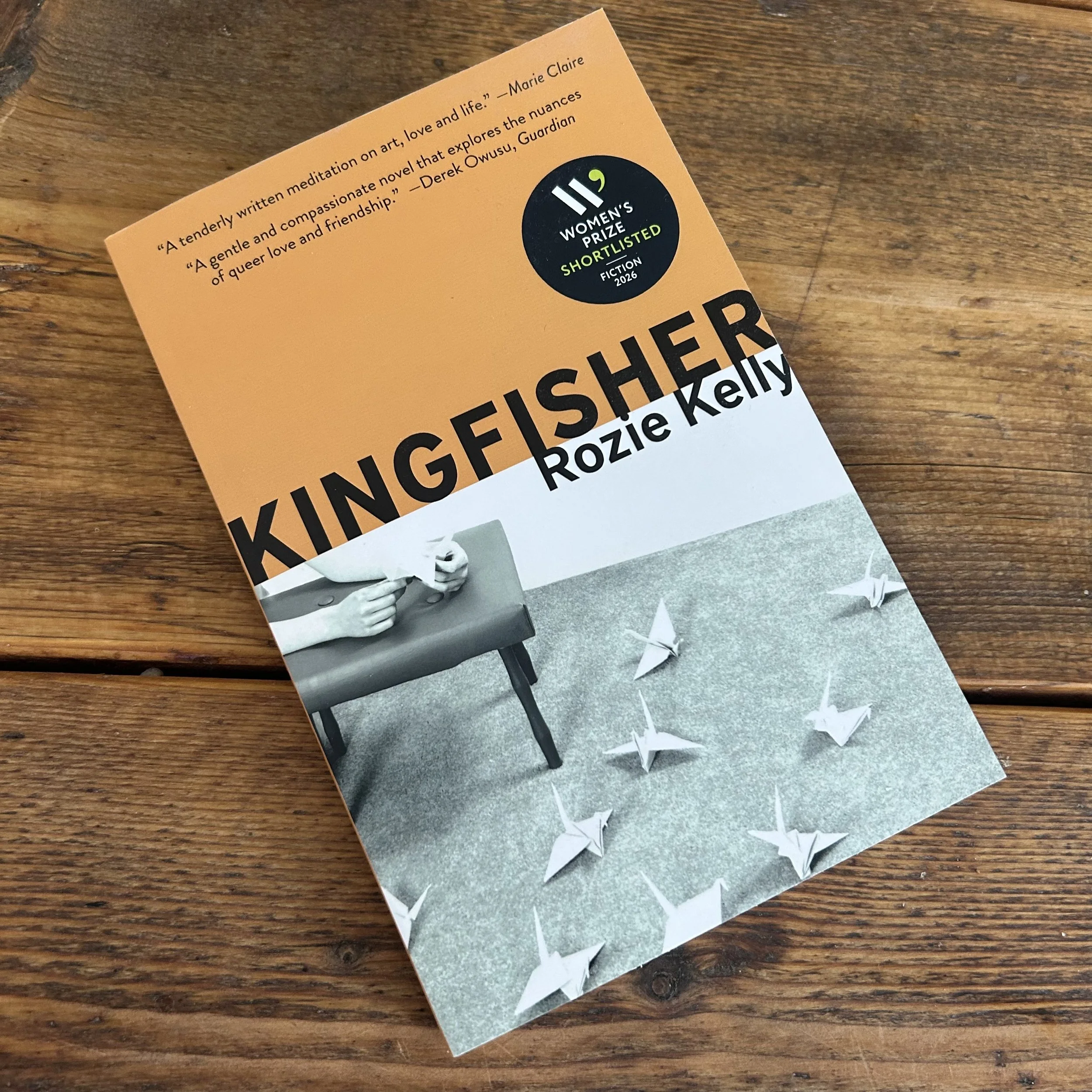
Why this one?
Reading the Women’s Prize for Fiction shortlist, after reading some from the longlist that mostly didn’t make it. This is my final read from the shortlist, just in time for the winner announcement (due tomorrow, 11th June).
Rozie Kelly (c. 1990- ; active c. 2020-) is from West Yorkshire, England and currently lives in Hebden Bridge. After returning to higher education at age 27, she studied at the University of Manchester and subsequently undertook a Master’s degree in Creative Writing, graduating in 2020. She works for the Arvon Foundation, where she facilitates creative writing retreats and courses.
She was shortlisted for the PFD Queer Fiction Prize 2023 and was one of the eight participants in the inaugural Prototype Development Programme 2024. She won the 2024 NorthBound Book Award for her (then unpublished) debut novel, Kingfisher, which was published by Saraband in 2025.
Thoughts, etc.
Kingfisher tells the story of an unnamed queer man, a writer and university employee whose relationship with his partner Michael (a successful gym entrepreneur) is falling apart at the same time as he becomes obsessed with a female colleague (and far more successful writer) known as ‘the poet’, with whom he begins a complex relationship. His mother, Hetty, treated him badly in childhood in ways that are not fully explained and persists in expressing her homophobia. She is in a nursing home and he occasionally makes grudging visits to her with Michael. As the book develops, he ends his relationship with Michael and spends more and more time with the poet. Hetty becomes critically ill and the narrator decides against seeing her before her death, but as the poet suffers a re-emergence of her prior breast cancer, he effectively becomes a carer to her. Their complex relationship becomes the inspiration for him to restart his writing and leads to him securing a significant book deal.
I had a bit of a hard time with this book. Like Heart the Lover it’s positively riddled with illness and descriptions of suffering and death, which at the present moment I’m not in a brilliant frame of mind for. Ignoring this challenge, though, I found a lot to admire. I thought the central character was very well rendered, certainly not especially likeable but relatably complex. He’s ultimately a fairly masochistic character, something that comes through in his sexual relationships and ultimately in the role of subservience he eventually happily accepts with the older poet, as well as in his occasionally nihilistic exploits and narcotic consumption. He’s probably not the kind of character that everyone will enjoy reading, but I found his inner world pretty compelling.
I also thought the web of relationships around him was nicely put together. Michael is the most straightforward person in his world, someone that perhaps gave him some sense of normality in his life, but ultimately he’s too much of a contrast to the narrator’s artistic complexity and their relationship can’t be sustained in anything other than its sexual form. His friend Jessica is also an interesting addition, another character that adds a degree of ‘real world’ grounding to his life which otherwise seems subsumed in the literary world (both literally and figuratively). She’s an advertising exec, dynamic doer, and general force of nature who stands by the narrator despite all of his flaws and enables him to pull through his challenging circumstances.
The poet is obviously far more complex, a quasi-mythical character who the narrator seems to idolise even as she treats him mainly as someone to help serve her needs. Ultimately she’s a successful inversion of the usual ‘older male’ trope, providing the anchor to the book’s interest in interrogating power dynamics. Ultimately I did feel that some of her complexity rendered her a little abstract and mysterious, less fully-formed than many of the other characters in the book. But perhaps that’s part of the point - she’s an object of desire that the narrator never fully understands, with many of her important truths deliberately withheld. She’s a muse, a symbol, an abstraction to the narrator in some senses, but also one with a very real story and suffering that means we do care about her as she begins to disintegrate.
His relationship with his parents is less foregrounded - his father is long gone, but he seems to experience a persistent sense of loss which comes through in snatches of recollections (or possibly imaginings) of moments with him, as the novel progresses. He can never really forgive his mother’s ongoing cruelty, but her death gives him some degree of closure and even satisfaction. These relationships seem to be the ones that are truly haunting him through the book, and which his existing relationships (with the well-meaning and potentiallly substitute parental figures of Michael and Jessica) have never really helped him untangle. His reckoning with the poet, someone he respects as a person and for her art, and ultimately who enables him to play a role of submissiveness and subservience, seems to enable him to more adequately deal with some of the trauma of his parental relationships, and begin to move forward in a more purposeful way with his art and life.

Score
8.5
A book that is certainly more complicated to unpick than many of the others on the shortlist. There’s little in here that’s black and white, and it sits more squarely in the purely ‘literary’ space, with more use of metaphor and poetic allusion than anything else on this year’s generally more straight-down-the-line list. I found that relative difficulty quite rewarding, though. I wouldn’t say it’s my absolute ‘favourite’ on the list as it’s a challenging read in terms of its subject matter, but I did admire it.
Ultimately I think my ranking is something like:
The Mercy Step (9)
The Correspondent (9)
Kingfisher (8.5)
Flashlight (8.5, though I read it so long ago this could be misplaced)
Heart the Lover (8.5)
Dominion (7.5)
There are a bunch of books on the longlist that I think would have sat at or near the top of this list and I think would have made for a more satisfying shortlist. Notably Audition which is comfortably my favourite from the whole list, but also the likes of The Benefactors, A Guardian and a Thief, Wild Dark Shore and The Others. For me this wasn’t the most enjoyable Women’s Prize year in Shortlist terms. There are certainly a bunch of very good books in there, most of which I wouldn’t mind seeing as the winner, but it definitely feels like a year in which some truly great reads were overlooked.
Like the sound of this one? Buy it at bookshop.org.
(If you click through and make a purchase, I may earn a small commission from Bookshop.org at no additional cost to you, which helps support local independent bookshops. I’ll only share these links for the highest rated titles on the site. )
Next up
TBC!